Staying Grounded in Basic Storytelling Principles
This last year I’ve really gone ‘dark’ as they say, which means I’ve been very quiet (and unproductive) on all fronts. It’s been a good break, a needed break so I could recharge and take care of myself, but now it’s time to get back to work.
When I’m struggling with a section in my WIP (work in progress for you non-industry folks), or trying to re-wrap my mind around my story I return to basic tools for guides out of that self-imposed darkness.
Larry Brooks, who if you don’t know him yet, you should – who writes writerly-how-to books is one of the gurus (via  his books and blog at Storyfix.com) that I return to over and over again. Not because I’m that stupid (well, not always) but because stories, characters, plots, themes and all the magic elixirs that make up a story world, are fluid, changing, often morphing into something completely different from what I thought I started out to write. So back to the basics I go. If I don’t go back to those grounding basics of storytelling; premise, concept, plot, theme and so on, then I get lost in the words. SO MANY WORDS! And when I get lost in the words it takes FOREVER to finish a project, be it novel, short story or essay.
Oh, and when I said my story could ‘often morph into something completely different’ I meant it. I recently had a conversation with Hollywood script guru, Michael Hague (author of too many books to mention here) who asked me which aspect of my story fascinated me the most, because, he said, that’s where your passion lies and that’s what you should follow. My answer shocked the baggeebies out of me. So, with that answer, which I wont’ share here…maybe later in another post – changed my entire story. After the initial shock, I was happy our conversation happened when I was only 150 pages in.
When a local writer friend, Pam Carter (Writer, Producer and Playwright) asked me about premise,

I realized during our conversation about hers that I actually needed to re-consider my original premise now that the story had changed so dramatically, and so revisited all my information on premise and concept. Again, back to Larry Brooks
who teaches this stuff like hell fire and damnation from a preacher ablaze with the truth. If you’ve seen him live you know exactly what I’m talking about.
So while I press through; re-entering my story world, getting back into a writing groove, editing, re-outlining and all the other blue-collar work a writer does to create a story-world and narrative that will be of interest to readers, I wonder, what tools do other writers return to time after time, and why? Okay, back to work.

Why Authors Should Be Virtual Vision Boarding
The research aspect of writing historical fiction is a full-time job and often disregarded once the book is done. Add to that reader’s expectations have elevated, so authors are obliged to meet their escalating anticipations with additional information/entertainment. For example, with the sensitive subject matter of the holocaust in my second novel, keeping research organized and verifying facts is vital. For me that’s made easier by using virtual vision boarding on Pinterest to create story-boards, story images, park my research, and SO much more. That way I have the images and links to critical research at my fingertips for referencing later in blogging, tweeting, Facebooking and so on, utilizing my research by turning it into marketing gold. If you’re just beginning your first novel or starting your fifth novel, virtual vision boarding is a great author’s tool – for research, writing and marketing – that’s never too early or too late to utilize.
I’ll be sharing this information and more at Edmonds Community College in July. Click here to sign up for the workshop.


A Writer’s Strategy Saves Time in Marketing
Writers, did you know that having a writing strategy could save you time in marketing? And I’m not talking about the long disputed ‘pantsers vs planners’ kind of story approach, I’m talking about what types of objects and subject matter you select for your story landscape. I’ll be teaching a workshop on that in July… I’ll share more about it later.
Anyway, every published author I know complains about the amount of time they spend marketing once the book is published. So obviously saving time in marketing is vital if you ever want to write again once your book is released into the world, which I learned waaay late in the game, but you can benefit from my hard-learned lessons.
What I didn’t know then was that the best time to start marketing is before it’s published, long before, like when you’re researching your story. In the workshop I’ll share how you can turn that research into marketing gold. I’ll also share time management tips for social media, like;
Did you know the perfect length for a twitter headline is 6 words? Why waste time thinking of more when 6 (or less)  will do. KISSmetrics has reported that readers absorb the first 3 words of a headline and the last 3 words, making a six-word headline ideal.
And did you know that the school of thought on headlines (being full of keywords and information rich) is old school? These days instead of being helpful in the traditional sense headlines are now meant to raise curiosity and capture clicks.
Today’s effective social media headlines don’t contain much context and are merely a worm on a hook – it’s the click through that matters. Once they’ve clicked then they can read the article, buy the book or watch your video. But you’ve got to hook them first, so effective marketers rely on shock, emotion, or curiosity factors. Readers don’t know what to expect, and that’s why they click.
Whether you are an aspiring writer, published novelist or short story writer these tips will enhance your writing, social media and marketing time management. In the workshop I’ll share a lot of writing and social media information for example, 8 effective headline strategies backed by psychology – why waste time when you can rely on science….
Join me JULY 15th at Edmond’s Community College for a fast-paced, hands-on 3 hour workshop about using objects in writing and how to transform those objects into marketing gold. How to use your research as promotional fodder and why digital vision boards are a vital tool for writers, artist, and any small business. Click here to sign up
Workshop – Part Writing, Part Marketing
I’ll be teaching a workshop in July at Edmonds Community College…here’s the 911 – or is it the 411? I’m SO not hip. Either way, here’s the info;
| Vision Boards to Enhance Your Writing AND Social Media Presence Hey, writers, vision boards can transform your storytelling and spin your writing research into marketing gold. Learn how objects and images help tell your story, then convert that story world into social media fodder, and launch or enhance your online presence long before the book deal. This part-storytelling and part-social media hands on workshop is for writers of all levels. Lots of handouts and worksheets. July 15th 9:30- 12:30 $39.00 |

Egyptian Belief in Ghosts Inspired my Story
The most enduring Egyptian understanding of death was that it was a continuation of life on earth but lacking any displeasure, loss, or distress, in other words, paradise. And unlike what most say these days, “you can’t take it with you”, most bygone Egyptians believed the opposite, “you keep it forever.” This insight into the afterlife ebbed and flowed throughout history. Along with this belief was an understanding of otherworldly spirits – ghosts – which, more so than the view of the afterlife, remained unaffected from the earliest indication through the end of ancient Egyptian history: ghosts were as much of a reality as any other part of life.
The essential value of Egyptian culture was ma’at (harmony, balance) which the Egyptians observed in every part of their lives; among the most vital of these was the appropriate burial of the dead. A human being was considered a traveler on a narrow road from birth, through death, and on to the afterlife. We know this from tomb paintings, inscriptions, and statuaries for the soul intended to guide their return and harmless visitations on earth, but the spirit was anticipated to depart to its own realm fairly hastily. The appearance of a ghost, and especially its interaction with the living, was a certain sign that the natural order had been disturbed and the most common cause of this distress was a spirit’s displeasure with its body’s burial, the condition of the tomb, or a lack of reverential commemoration.
And this is where I begin my story, my WIP, Garden of Lies. My main protagonist, Esmée is a holocaust survivor, a clairvoyant who sees and hears the great departed. Having grown up the child of two archeologist she spent much of her childhood in Egypt in the 1930s. As a child Esmée absorbed her mother’s teachings about ancient Egyptian goddesses, and their foreign surroundings which ignited her imagination. Flash forward to after the war, after Gross Rosen Concentration camp, and we find Esmée troubled and preoccupied with not knowing the location of her parent’s bodies which did not receive proper burial, how (exactly) the Nazis murdered them, and how she can respectfully honor them.
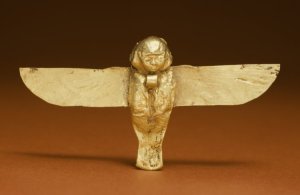
Though Esmée is Jewish, her ma’at (harmony, balance) has been disturbed. She sinks into her adopted Egyptian rituals. This brass amulet is intended to keep evil spirits away. However, in Esmée’s case it hasn’t worked.
In doing my research I have grown even more fascinated by ancient Egyptian beliefs, practices, and lives.
More to come….

