Social Media Sin – Saying good-bye to my other blog at Literary Liaisons
A HUGE Social Media Sin – So Sorry
(repost from Literary Liaisons)
I’ve committed a horrible sin. Well, a social media sin anyway. I’m not actually willing to talk about other sins I may or may not have committed, just the SM ones. Anyway, I took 6 months off from blogging. Yep, unforgivable, I know. This happened for two reasons: first, I needed to focus on my health. Which I did and I’m going to be fine (thanks for asking). Second, after nearly 9 years of blogging about writing, the writer’s life, and storytelling I felt I had said all I had to say and that others were carrying that torch far better than I.
The break has given me a little perspective.
When I originally started blogging my greatest desire was to be a published author, which I am, and to understand writing (ongoing), storytelling (an evergreen topic) and how to improve my craft – and as I’ve said many times over the years, writing is a life-long apprenticeship. When we stop remembering that, we stop learning, when we stop learning the stories we want to tell become stagnant.

Me with Stewart.
I was stagnant. Maybe it was the stress of dealing with chronic cancer, maybe it was that I’d lost interest in what I was writing, maybe I’d stopped learning, either way, I was stagnant and stagnant is not a good seat for creativity.
A few years ago I had the opportunity to know and to write with Hollywood royalty, the amazing Stewart Stern. Stewart once told me he had stopped writing at one point in his life because he’d lost the spark. “When you lose the spark, kid,” he said, “step away until it comes back.”
So, I stepped away until it came back.
The time off gave me an opportunity to get reenergized and plugged into what I was/am passionate about in storytelling. So instead of writing about the things I’ve written about in the past (how-to stuff) I will write more about my story-telling passions. Like currently for my next novel I am studying and writing about Egyptian Burial Rituals, among other Egyptian rites, for my protagonist, Esmée who grew up going on dig sites with her parents prior to WWII. Right now in my story creation phase these things fascinate me and deepen my story world exponentially.
I also was torn between continuing to blog here on Literary Liaisons or just blogging directly from my web site www.MindyHalleck.com. During my time off I realized that maintaining two blogs is just too much. SO, I will leave Literary Liaisons up as a resource for writers, but will blog from MindyHalleck.com from now on.
I appreciate and value your continued subscription to Lit-Liais, and sincerely hope you follow me over to www.Mindy Halleck.com and sign up to receive my ongoing posts and thrice yearly newsletter, and of course I hope you continue to use Literary Liaisons as the writer’s resource it was always intended to be. Either way, keep putting words on paper. Happy writing, Cheers, Mindy
P.S. If you have a writerly how-to post you would like to share on Literary Liaisons as a guest writer, Please send me your quick pitch (2-3 lines about topic and resources) and I’ll consider it as a guest post on Literary Liaisons. If I like the idea I’ll send you a message about how to submit your article for consideration.
Meanwhile please follow me on social media

If you liked this TWEET IT OUT! Thanks, Mindy
Pinterest (where I have a great writing tips board)
Instagram (which tends to be more about my adorable labradoodle than writing)
Authors & Social Media – My Number One Tip
Over the last three weeks I have had numerous conversations about authors and social media. At the University of Washington I had the opportunity to speak to a senior fiction writing class of aspiring writers, and they were surprised when I said to start building their platform NOW, before they are published.
Why? Author platform is what agents and publishers are looking for. As Jane Friedman explains “Author platform is one of the most difficult concepts to explain, partly because everyone defines it a little differently. But by far the easiest explanation is: an ability to sell books because of who you are or who you can reach.”
I like to share simple ways that I’ve learned about how to start building and or enhancing your author platform through Twitter, Facebook, Pinterest and more. Anyway, it’s always great (for an instructor) when you see the light bulbs go on in the faces of your audience, as I did at the U of W a couple of weeks ago. Author platform does not have to mean Kardashian like followers, but at least a presence on social media via whatever outlets (Facebook, Twitter, Pinterest, etc.) you feel comfortable with. And myNUMBER ONE TIP for social media success is; pick the one that you can envision yourself doing, possibly even enjoying, because if you don’t enjoy it you will fail. If you enjoy it you have a much greater chance of social media success.
I also spoke with Edmonds Community College this week about doing a summer workshop on this evergreen yet always changing, topic. I’ll post that date once it is confirmed.
If you’d like to hear a bit about my thoughts on writing and marketing you can listen to this interview I did yesterday with radio talk show hosts, Stone Payton and Lee Kantor on Business Writers Radio. And I must say, after doing several radio talk shows these gentlemen are standout pros – GREAT hosts. I enjoyed chatting with them and hope to again. 
Why We Write the Stories We Write
It’s commonly accepted that Nazi Germany’s concentration camps were/are the epicenter of human sorrow and suffering as a result of human against human brutality. These places stand as tributes to the human race’s capability when fear leads to either blind faith in religion or government, or when vile rhetoric becomes our prime cheerleader. They are living tombstones honoring, not just the victims, but also the sins of those who shot innocent people with wild glee, locked gas chamber doors against the screams of their victims, or, perhaps more inexcusably, closed their eyes to grievous inhumanity. Or worse yet, today in 2017, those who deny the holocaust ever happened. The politics of today have everything to do with why I’m writing my next novel, Garden of Lies, not that it’s about politics specifically, but because it puts a face on a victim of the last time people endorsed fear  and anger as their guide and allowed them to justify releasing the largest gathering of sociopaths ever – in Nazi uniforms – on an entire population. That’s my two-bits, now back to storytelling…
Using imagery in storytelling means constantly looking for images, old photos that will help me make the world I am creating (WWII concentration camps, 1960 Portland Oregon, and 1930’s Egypt) come to life in my head and ultimately in a reader’s mind. I collect images and information for my research and save it on my Pinterest board. For example, this image helps me envision what my main protagonist, Esmée sees in her dreams – memories of Auschwitz – and the ghosts who haunt her. Visit my Pinterest board to see the world I’m creating. Please follow my board if interested. Though I could not find (via Google image search) the source of this photo, I have linked it to the info I did find. http://www.mindyhalleck.com
If you liked this TWEET it out! Thanks. 
Objects in Story-telling
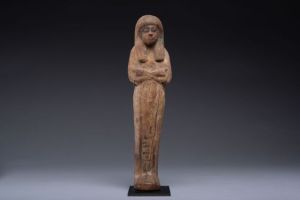 This is an image of an Ancient Egyptian Shabti, the sort of idol the main protagonist in my WIP (work in progress) Garden of Lies, collects. Why? These objects connect her to her childhood and more importantly to her parents whom she tragically lost in the Holocaust. The object reminds her of traveling Egypt with her archeologist parents, studying burial rituals and so forth – now she is trapped in a dance of death and mourning.
In her mind these objects keep her connected to her departed. Objects in storytelling can be a vital part of the plot.
Please visit my Pinterest page to see other objects and story-telling images for my next novel.
Shabti Dolls: The Workforce in the Afterlife

A Writer’s Dreams
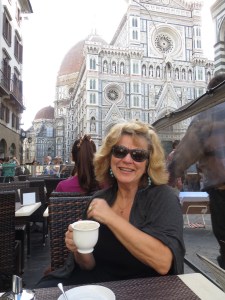 Today what’s on my mind is achieving dreams, despite all the mud and muck of politics right now. And sometimes to position myself mentally I envision a dream come true from my past, and thankfully for me there are so many. This picture is of me sitting in a cafe in the Piazza di San Giovanni, the plaza located directly in front of the Duomo in Florence Italy, writing. I had dreamed of this place where famous artists and scribes of the ages gathered, walked, philosophized and created, since I was 16 years old. It took a while (I’m a bit past 16), but I got there. It was such a happy day. So while my hubby climbed the gazillion stairs of the Domo I had that independant day of which I dreamed so long ago: I walked into a posh cafe, and with my bumbling attempt at speaking Italian I ordered an espresso and sat outside and was mesmerized by the world. Just being there, finally, was pure magic. I started to write about when I originally had the dream of being their. The piece I wrote that day was a memoir piece and is being saved for when I do finally write that memoir. What memory from your own past inspires you? Sit down and revisit that, then start writing.

