After a 6 Month Blogging Break…I’M BACK!
 In June 2018, I decided to scale back on activities that added to stress, you know that ‘One more thing to do today’ kind, and other energy draining commitments that kept me from my writing projects. During those months I also resigned from two committees that took my time in ways that were not creative, and then signed onto a board, Epic Writers Group, where I can be an active participant in the creative writing community. It’s CRITICAL to all of us to assess what makes us happy, what adds stress, or what makes us sick, and then do a course correction. I had always done this in my annual business review of my goals and aspirations, but am very guilty of not doing this in my private and or writing life. So KUDOS to me for doing some long overdue adulting. Oh, and that’s another VERY important aspect of this reassessing, realigning and re-imaging of life goals, giving YOURSELF a pat on the back.
This month I feel re-energized and recommited, and will get back to my blogging about writing, the writer’s life and whatever else strikes my fancy, but for now, THANK YOU for hanging in with me as a follower. As a gift I’d like you to receive  this updated 2019 booklet, titled 17 Blogging & Social Media Tips for Writers, just click here to download.
MEANWHILE, keep writing, keep submitting, and of course keep reading other writer’s work. And local writers, there’s a #writing contest at EPIC GROUP WRITERS in Edmonds Washington that is open to all. Check it out via the below information. Good luck.
** Attention Writers in Washington State **
You are invited to enter your prose and/or poetry
EPIC Group Writers Writing Contest
~ Make us laugh, cry, and think ~
ENTER NOW!
** EPIC Writing Contest is now open **
Welcoming entries in poetry and prose
Friday, February 1 through Friday, April 5
Adult and Student (grades 8-12) categories.
Cash awards for 1st and 2nd Place Winners.
Student Winners’ school libraries also receive a cash prize.
Publication on www.epicgroupwriters.com
Submission dates: Friday, February 1 through Friday, April 5, 2019
Submission fees: EPIC Members (adults): $10.00 per submission
Non-members (adults): $15.00 per submission (Not a member? Click here!
Students (grades 8-12): FREE
CLICK HERE TO SUBMIT
A public reading and reception will be held at the Edmonds Library on May 16, 2019
EPIC Group Writers
Every Person is Creative!
www.epicgroupwriters.com
Facebook: EpicGroupWriters
Twitter: @epicgroups
Why Is Storytelling SO Important?
I’m a storyteller. Most of my friends are storytellers; playwrights, poets, novelist, singers, songwriters, and artists of all mediums. We all tell stories for different reasons, and yet for the same purpose, storytelling aids us in understanding the world around us.
Storytelling predates writing. The most primitive forms of storytelling were usually oral expressions. Storytellers come in many forms, with many voices and tools, from poetry and literature to graffiti and fine art. We need storytellers, artist and writers, to elicit passion and emotions, especially in dark times when we can so easily avert our eyes from troubling events like a cultural revolution, rebellion, social injustice, corrupt politicians, police brutality, the imprisonment or genocide of an entire people.
Though the ancient origins of storytelling have vanished into the mist of time, the importance of storytelling and those who tell stories has not. From cave dwellings to the recontours of Native Indian lore, families and cultures with strong narratives and passionate tellers, thrive in their collective story.
Think about times spent sitting around the kitchen table with your family – your witnesses on this journey – as they tell and retell all the often cringe-worthy memories of you as a child, or their experiences during the Great Depression, or whatever the family stories are. Think how bonding that is/was, how it informed your sense of who you are and where you come from. At my grandma’s house, all of us crowded into the yellow-vinyl kitchen booth, drank weak Folgers coffee, my aunts’ chain-smoked Salem cigarettes, and talked like ‘mag-pies’ grandma always said. And at that jam-packed table every story started with “I remember that time you….”
Capturing and retelling the stories of our collective history is vital to understanding our existence on this planet – trust me, when grandma is gone, you’re gonna wish you took notes, and you’re gonna remember with heartache and joy, every story she ever told you. Our stories are important.
Storytelling is vital to the human experience. It allows us to digest information with greater ease by more effectively linking that information to our feelings and then our thoughts. Generally, once we’ve felt something, we don’t forget it. I recall years ago, seeing the movie, Dead Man Walking, and how when my friends and I left the theater we talked about the death penalty, I recall feeling very differently about that controversial topic after seeing one man’s poignant story.
One of the reasons I wrote my novel, Return to Sender was to reiterate the history (lest we are doomed to repeat it), and the stories I grew up with as the child of a Korean War veteran, about the atrocities of the brutal North Koreans against their own people, and most especially against their own orphans. A topic as timely today (sadly) as it was in the 1950s. In my novel I paid tribute to the most haunting aspect of the Korean War for both my father and my father-in-law; the slaughter of innocent children by their own people. Having these precious photographs of many of these children made their stories personal to me.
There are certain aspects of history that resonate deeply with all of us. For example, my talented neighbors, Jan and Chris Hopkins, who make a great mead (home-made wine), but who are also internationally recognized, multi-award-winning artists, illustrators and storytellers. Their most recent creative endeavor of depicting the WWII internment of the Japanese in America, was motivated by Jan’s desire to learn more about her cultural identity. As a child of detained Japanese Americans, there was a lack of information about her family legacy and the ordeal of internment that they endured. Jan needed to know her story, so she and Chris have set out on a mission to share their stories through visual arts. Their joint exhibit at Everett’s Shack Center for the Arts starts June 21st thru September 2018.
Chris is a historian through his art. His paintings tell very specific aspects of the American story that resonate with

him on a soulful level. He captures moments that harken back to moments like this young Japanese-American woman who is pregnant, alone and just ‘relocated’ to an internment camp – what does the future hold for her and her unborn child now that her country (America) has turned on her? It is important to humankind to keep those stories alive so they never happen again.
Chris also painted an entire series of over 60 paintings of the Tuskegee Airmen which travels the country in art shows, like locally at the Shack Center in Everett. The Tuskegee Airmen series portrays the adventures of the first African American fighter pilots, their crews, families and legacy.
As an illustrative historian Chris has captured this pivotal moment in time; At the onset of World War II, the segregated US armed forces declined to train African Americans as pilots until a lawsuit opened the door. The Army Air Corps acquiesced to an experiment training pilots at Tuskegee University, Alabama. In March 1942 the first class of African-American aviation cadets earned their silver wings and became the nation’s

first black military pilots. Between 1941 and 1945, Tuskegee trained over 1,000 black aviators for the war effort. Chris started his Tuskegee Airmen series as part of his work for the Northwest chapter of the Air Force Art program. Over the years, the series evolved beyond the Air Force Art program to become a personal mission and passion for him. Every one of these paintings tells us a vital part of our history; who we were, who we are now, how far we’ve come, and sadly how far we have to go.
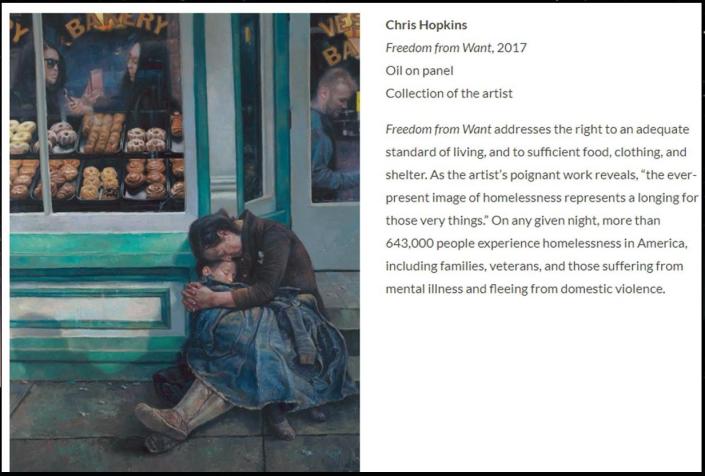
Or below, this modern-day image, social commentary, where a homeless mother and her child sit starving on the steps of the land of plenty, a posh bakery, where inside, too busy to notice, are two girls on their phones. Just as I tell stories with words, Chris uses images, and is a perceptive storyteller of our times, the good and the bad.

Regardless of medium or craft, storytelling is significant because it can illuminate moral, ethical, spiritual lessons in non-preachy ways that people can easily contemplate. Great stories engender empathy by helping people relate to someone they may never have connected with before.
Just as important as our intimate family stories are in reminding us where our faith and courage comes from – be it strong Scottish, Jewish, Irish, or French roots – and what our ancestors overcame, it’s also vital to keep historic stories alive so we never forget what our fears and prejudices can become.
What stories matter to you? Tell them.
“There is no greater agony than bearing an untold story inside you.” – Maya Angelou
And, big kudos to my neighbor; Art Work by Chris Hopkins Selected for Inclusion in Major Traveling Exhibition Organized by Norman Rockwell Museum – Reimagining the Four Freedoms
In 2017, the Norman Rockwell Museum in Stockbridge, Massachusetts, sent out a call to artists to create works that would reimagine President Roosevelt’s Four Freedoms—Freedom of Speech, Freedom of Worship, Freedom from Want, and Freedom from Fear— or explore the meaning of freedom today, for possible inclusion in the major touring exhibition: Enduring Ideals: Rockwell, Roosevelt & the Four Freedoms. From 1000 submissions, 36 artists were accepted—including two works by local artist, Chris Hopkins—for the contemporary section of the exhibition, titled “Reimagining the Four Freedoms.”
In our time of troubling HOMELESSNESS in a country of plenty, this painting is particularly poignant.
If you liked this please share, Instagram, Facebook, Pinterest or Tweet it out. Thanks. Mindy



Can We Rise Above Our Words?
Lately, I’ve become especially in tune with the way people describe their relationship with cancer – and trust me, it is a relationship – or the words they use when expressing compassion toward me. It’s very common to hear statements like “You’re battling this disease” or “you’re gonna win the war” or other combat-like metaphors. I, myself even use the term ‘cancer-warrior’ just because I like the sound, and besides, who doesn’t want to be a warrior, right? But in my recent reanalyzing of this relationship with dis-ease, I am reviewing my own language. I’m a writer, words are my play things, I can do this.
I’ve come to realize that being a warrior requires a battle, it is a combative term after all. And therein lies my problem.
I’ve been living with cancer for two decades now. I have had three major surgeries and two minor. I’m down a couple organs and twice have had my throat cut from jugular to jugular – only nicked once – and have lived to tell. Alas, here I am again exhibiting irregular tests, shadowy images on scans and abnormal even ‘aggressive’ tumor indicators. Mine is a rare cancer so there isn’t much study available. As a matter of fact last week I was told that my closely-monitored 20 year old file is a great resource in the search for answers about Medullary Carcinoma – cool, glad I can help. Anyway, I’m tired of partaking in such an adversarial relationship. Besides, maybe all that fighting has added to the struggle. Besides, words are powerful things, and as my gramma used to say, ‘you can never rise above your words.’ So if I can’t rise above them, then I need to raise them to level at which I would like to live.
Cancer, at least my cancer is something I have to co-exist with. Oh sure, it may be like living with a troublemaking roommate I can’t get rid of, but live with I must. It’s in my throat, so I live with a mostly metaphorical knife at my throat, but sometimes that metaphor turns literal and surgical cutting ensues.
For a long time I also used antagonistic, rebellious ‘I’m goin’ to war’ metaphors. But now I’m attempting to alter  my orientation from combatting my dis-ease to embracing and partnering with it. After all, we do share the same space, so it follows that we have to learn to connect and peacefully co-exist. HA! As I write this I keep imagining the roommate, Spike (played by Rhys Ifans) in the movie, Notting Hill. It made me smile time and time again when I was recuperating from one of my surgeries a few years ago. It hurt to laugh then, but Spike, cracked me up!
Anyway, I’ve come to realize that I can’t truly heal myself of something I’m not connected to. Have I spent all these years putting my energy into fighting instead of healing,  meanwhile thinking the two were synonymous? What’s that Tony Robbins quote, ‘where focus goes, energy flows’… so true.
Well, I’ve decided to focus my energy and thoughts on healing instead of fighting and that requires a new set of skills and language. Kinda like Hugh Grant’s character, William Thacker in Notting Hill, had to do with Spike. He really had to make peace with his undesirable roommate because they shared the same space. Ultimately they became great friends.
Making peace, not war may be the best motto in life in general and may serve the overall quality of life whether you’re a patient or not. Aiming our energy towards the healing process helps us connect with our journey through any kind of dis-ease (illness, mourning, divorce, horrible roommates, etc.). It’s far more empowering than directing energy towards the anger linked with the cancer, which keeps you interlocked in a victim role and feeling you need to fight. Maybe changing the words, the language of war to a  language of compassion and self-love is the path that will illuminate this often exhausting and emotional journey. Either way, since I play with words, that’s what I’ll be doing.
Oh, and if you aren’t familiar with these images of Spike, then you have to watch Notting Hill. He’s brilliant! Still laughing.
If you liked this please tweet or instagram it out.
Author Survives Parenthood and Writes Tell All
Now can you think of a book title that would horrify your children (and possibly grandchildren) more than these  seven words, Author Survives Parenthood and Writes Tell All??? Not only would it garner immediate interest (fear) from your children, but because people are voyeurs by nature, it would grab the attention of readers, at least enough for them to pick it up off the shelf (old school bookstore or virtual) and give it a look-see.
Seizing a reader’s attention via a snappy title is a first HUGE step for author-kind. With a great title you’ve won the first battle, but there are so many more battles to come. Because next you must have written a great first line (hook) and follow that up with a good premise, plot, and great storytelling.
It’s true, readers judge books by their covers, paying particular attention to the title. Your book title can make or break the success of your book.
There’s a good article on this topic at Authority Pub. Here’s an excerpt I borrowed to make my point. ….According to research conducted by author, blogger, and speaker Michael Hyatt, consumers check out a book in the following order:
Title
Cover
Back cover
Flaps
Table of contents
First few paragraphs of the book’s content
Price…
Note that NOWHERE DOES IT SAY AUTHOR’S NAME.
So, in addition to scaring your children, what should a title do? If you take a peek at the above referenced site you’ll see some good examples of titles, both fiction and non. In addition, a title should intrigue, peek interest, shock, make a reader wonder What? Who? Why? offer help, or offer escape. There’s a plethora of opinions on what a title should do and how to do it. So do your research and carefully decide what works for your book.
Then after you have your title you can see if you’re on the mark.
LULU has created a free tool that will grade your title based on its probability to be successful. To create it, Lulu and their team of statisticians deliberated over a list of the best-selling titles from 1955 to 2004 and eventually created a super cool tool, the Lulu TitleScorer. Put your title in and see how it scores. I wish I’d of had this when my first novel came out, the title, Return to Sender only scored a 22% probability of success. UGH!
Also, here is a GREAT article on using power words and creating attention grabbing titles. Though the article focusing primarily on non-fiction, it’s all good info to keep in mind when crafting a title that will jump off the shelves. https://www.tckpublishing.com/how-to-write-book-titles-that-sell/
“A good title tells what the book is about. A great title tells what the end destination is. A truly superb title is one that tells the end destination and also appeals to core human desires.”
— Buck Flogging at Archangel Ink
If you liked this please tweet and retweet. 
Personal Creative Contracts – The Artist’s Way
Back in 1995 when I first purchased The Artist’s Way by Julia Cameron, I was still very entrenched in the day to day of making a living and surviving in a competitive business world – in other words, living a life based on everyone else’s expectations. The concept of treating my writing like a business or frankly, even respecting it myself, was an indulgent idea I didn’t have the luxury (or foresight) to comprehend. Consequently, my writing remained in the hobby category of my life for those once in awhiles when I could get to it, like a chocolate sundae, a rare and special treat.
But then I read page 23 of Cameron’s book which contains the personal contract, one of the essential tools from the Artist’s Way. What I soon learned was (as with anything) that if I didn’t respect my creativity, neither should I expect anyone else to. I also realized that by not valuing my creative spirit, that spirit would soon die.
I started slow, setting aside time on my less busy days and going to a coffee shop to do nothing else but write. All I knew for certain was that if I stayed in my home office I’d be distracted every five minutes, so off I went. And I’ve never looked back.
The contract changed everything for me.
I’ve revisited this idea of having a contract with myself, protecting my creative life, numerous times since then – it never hurts to revisit, revamp and reimagine spiritual agreements now and again. Now, in 2018, my writing time comes first thanks to having this agreement with myself, one that must be honored for me to experience life on my own terms, not everyone elses.
I started actively pursuing this personal and deeply spiritual agreement in 1995, and by 2000 was in Ireland on a month long writer’s residence. And now a couple decades later I’m published in many genres and many vehicles (magazines, newspapers, books, etc.), and working on my 2nd novel and some short stories. I’ve learned that my writing is not some luxurious hobby, no, writing is breath, and writing is who I am. I have the contract to prove it!
I’ll be teaching The Artist’s Way at Edmonds Community College starting in 10 days. Hurry and sign up.


