
Touching. Words can be powerful stimulants, bad or good. I choose the latter.
memoir writing, fiction writing, storytelling, writers, PDX, Portland Oregon 1970s, D Street Corral
A Tragedy Inspired Poem
Recently, one of my poems was published in The Edmonds Beacon newspaper. The poem was inspired by a tragic car accident I witnessed several years ago. A scene that etched into my memory.
That’s how it often happens for us writers, something––a face, a scarf, a doorway, or an incident––imprints on our psyche and ultimately, we use it in a piece of work. Here is the poem that resulted from that tragic afternoon, followed by a brief epilogue.
SEPTEMBER MOON
Beneath the September moon
A flicker of weak light
The faint memory of her mothering years––lost
Unraveled
Tiny strings frayed
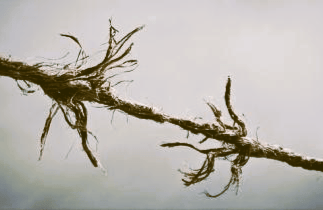
Scattered
Across the fallow fields of her life.
Alone in the darkness she feels
Loosely tethered to both worlds
One where she still sees her children
Hears them sing
The other where she floats endlessly in the hollow silence of night
Linked to them by one last ethereal string.
She closes her eyes
Afraid to see, to hear, to know,
What happened
––in her wine-colored afterglow.
Beneath a September moon
Reminders––
Buried deep
Lost in her spirit
The solitary tills of time
Of heart
And soul
Barren of love, barren of life
––and she knows
The piercing betrayal of one more glass of wine.
She now imagines her children as dormant butterflies
Who will not awaken any time soon
Their innocent lives arrested by
Mommy’s cocktails at noon.
Beneath fading lunations
She hears their cries
Her sweet butterflies
And she knows
Therein is her penance
Her dark destiny
––a life sentence
To carry aural witness of their final cries
To her spiritual wasteland
Filled with echoes of a mother’s bittersweet lies.
Tiny fingertips, like frayed strings
Once adored
Now, grasping
Reaching
Weakening
Tearing away from the cord.
Epilogue
This was a tragedy about a mother who attended a wine tasting luncheon, tasted too much wine, and then decided to pick up her two toddlers from daycare.
I was three cars behind her on the road when suddenly her car veered over the side of the road and crashed into a tree. We all slammed on our brakes. There was an officer parked in the parking lot not ten feet away. We all ran toward the car, but he arrived first and motioned for us all to stand back.
He pulled the mother from the front seat. Her head was gashed, blood dripping into her eyes, all over her hands, and was sprayed against her white silk blouse like blood on snow.
Her piercing screams horrified us all. She kept screaming and crying hysterically. “I’ve killed my babies!”
The five or six of us who’d leapt from our cars to help stood frozen. Collective dread filled all our faces. Approaching sirens echoed in the background.
The officer got her seated at the curb while the rest of us, me included, finally inched up to the car, fearful of what we might see in the back seat.
Her screams grew more hysterical. “I’ve killed my babies! … Oh God, I‘ve killed them.”
But as we all leaned down and trepidatiously peered into the windows, we were surprised by what we saw.
There in the back seat, staring at us, were two small children, safely buckled into car seats, looking at us like we were aliens.
They were fine. Afraid, but otherwise fine.
The mother was arrested for drunk driving and endangering her children, who again, I stress, were unharmed.
I learned later in the newspaper that her husband divorced her, and she lost custody and all visitation of her children. It was her third drunk driving incident, so she also went to prison for a time.
Perhaps her drunken terror that awful day was a mournful premonition. She did, after all, lose her children.
Transcending—Art into Poetry
During a recent workshop with the poet Susan Rich, on Ekphrastic poetry––which is poetry that explores art––at La Conner’s gallery/museum, MoNA, I became entranced with a painting, which I’ll share in a minute. Susan inspired us to find a painting or piece of art in the gallery, and using a rhetorical device known as ekphrasis, engage with the painting, drawing, sculpture, or other mode of visual art.
The term ekphrastic (also spelled ecphrastic) originates from a Greek expression for description. The earliest ekphrastic poems were vivid accounts of real or imagined scenes when writers in ancient Greece aspired to transform the visual into the verbal. Later poets pushed beyond depiction to reflect on deeper meanings. Today, the word ekphrastic can refer to any literary response to a non-literary work.
The painting that grabbed my attention and heart was The Longhouse by Helmi Juvonen, a gift from Wesley Wehr.
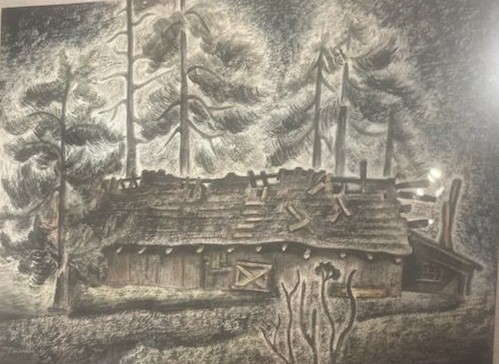
Helmi Dagmar Juvonen (January 17, 1903 – October 17, 1985) was born to Finnish immigrants (Helmi is Finnish for Pearl) and became an American artist associated with the artists of the Northwest School, and was active in the Seattle, Washington area.
She attended Queen Anne High School, and after graduating, worked various art and design-related jobs while studying illustration, portraiture, and life drawing with private teachers. In 1929 she received a scholarship to Cornish College of the Arts, where she studied illustration with Walter Reese, puppetry with Richard Odlin, and lithography with Emilio Amero. You can read more about her illustrious career here.
Sadly, Helmi was diagnosed with schizophrenia (manic-depression), and was committed to a mental institution in Elma, Washington, where she spent the final 26 years of her life. There, she was visited by artists and supporters, who facilitated wide recognition for her work, during her lifetime through many art museum exhibitions.

Helmi transcended boundaries
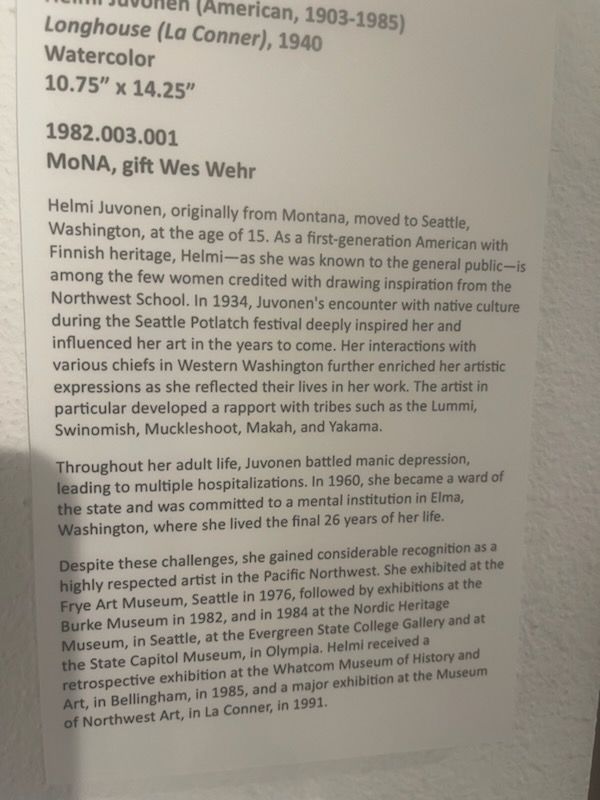
Native American culture cultivated Helmi’s creative spirit and empowered her to transcend the boundaries of ordinary life, poverty, and decades in a mental asylum. Her interest in identifying the origins of human culture, especially as it addressed the dichotomies of good and evil, led her to investigate these themes in diverse spiritual traditions – Judeo-Christian, Tibetan Buddhism, and the Baha’i faith.
And in the painting that captured me so completely, I sensed something beyond the brokenness of the exterior. Combined with my (limited) knowledge of native folklore from the Oregon Coast––gleaned while researching my novel Return To Sender––and reading a bit about the Lummi Nation (Pacific Northwest myths, I wrote the essence of what I felt and saw in this piece of art.
My poem from that day, which is also published on the MoNA website, is titled, Dancing with the Dead. Please visit MoNA’s site and explore all the poems produced that day. I have a 2nd poem on their site titled, Shadow Dance.
Dancing with the Dead
By Mindy Meyers-Halleck


Her house is ill,
they said.
Unhinged shutters,
band aids on the roof,
boards as exposed as skeleton bones,
a crooked door that’s lost its will,
and a roofline of sagging skin.
Her house is ill,
and it allows no one out,
and no one in.

The native peoples
said of their treasured mad woman
with skin white as pearl
that she is
broken in the head.
––but, that sacred wound,
They said,
allows darkness to seep in.
And in those spirit-filled shadows
she dances with the dead.

It took her a lifetime,
to embrace the brokenness in her head––
––her dark shadow sister who never saw the sun––
A sister coiled in nocturnal corners, dreaming of
wolves, trees, and danger
she was never able to outrun.

The trees that surround her house are
not quite alive
not quite dead,
they haunt the yard
––redolent with tears and blood of the fallen
sister who never saw the sun.
She is broken in the head,
they said.

In those mist shrouded trees
she sees
The Keeper of Drowned Souls.
His green long-fingered hand,
spindly as spider legs,
beckons her to follow
deep, deeper into the hollow.

The Keeper of Drowned Souls exists
transitory between the human world and the phantom world
he tells her,
her dark sister who coils like the snake
inside her house,
is condemned to endless hunger, agony, wandering and sin.
Because her house is ill,
it allows no one out,
yet he wants in.

She is broken in the head,
they said.
She observes ethereal phantoms,
and dances with the dead.
Fatal Flaw
Aside Posted on


WHAT IS A FATAL FLAW? —- It’s character arc 101.
This flaw is a character’s destructive character trait that is often the cause of their demise.
Great characters are generally wounded, and they don’t want to be hurt again, so they adopt new protective behaviors––drinking (Jesse Stone), tattoos (Lisbeth Salander) or unchecked ambition (Macbeth), whose fatal flaw ultimately led to his downfall.
But their new defensive behaviors are usually dysfunctional, increasing negative consequences and keeping them from attaining the things they desperately want and need.
And speaking of Macbeth, let’s look at the brilliant performance of the actor, Walton Goggins (pictured above) as Boyd Crowder in the hugely popular, Justified series. Boyd is a complex, brilliantly articulate man with a huge fatal flaw. His FF, GREED. Even when he has everything, he says he wants, love, money, and a possible escape plan, that one last big steal is too intoxicating for him to leave behind. He lets the love of his life walk out, believing he will get his hands on the elusive millions of dollars, earn her love back, and life will be wonderful again. Sadly, she realizes that’s not possible, because Boyd is weaker than his flaw.
Boyd, portrayed alongside his nemesis, Marshall Raylan Givens (actor Timothy Olyphant)––a friend from his coal mining days with whom he has a lifelong bond––is the shadow character and Raylan, the light––or at least, lighter than Boyd. When Raylan kills somebody, it’s justified (hence the name) but when Boyd does it it’s a criminal endeavor. Boyd serves as a caution to Raylan that one wrong step and he too, will cross the line and be on the dark side with Boyd. The two men, so similar it’s often hard to see any daylight between them, dance between light and dark. It’s a poignant relationship worthy of its own article.

Anyway, Boyd succumbs to his weakness and is ultimately destroyed by it. It’s a great example of a character’s fatal flaw. As #archetypes go, Boyd is a classic tragic hero, and an Outlaw Archetype as coined by Gloria Kempton in her book, The Outlaw’s Journey.
For a character to reach their arc, they must ultimately see that their emotional protection is essentially a theatrical mask––Boyd never reaches this arc. They must stop sabotaging themselves and make changes if they want to achieve their deepest desires––Boyd is doomed, trapped in a toxic game of self-sabotage. And the only way is to look the fatal flaw in the mirror and renounce it––Boyd believes he is right, righteous even, and that the lucrative albeit violent end will justify the vicious means. When he looks in the mirror, he sees only a righteous man who will do whatever it takes to have what he wants. Boyd, like Macbeth, yields all he is to this flaw and is overwhelmed by his own venomous yearnings.
This is a critical piece of the character arc puzzle authors must know.
Here’s a list of other fatal flaws you can tap into to help create interesting and multi-dimensional characters.

If you like it, tweet it out.
Tweet
Leave a comment
Thank you for this tribute. Poets all over the country will multiply her cry.
I’m so glad. I certainly was the goal.
The power of women to help each other shines through in this story.
Wow!! What a story – I didn’t know that Portland as it came after I left. Can’t wait to read…


From Maiden to Monster, Female Archetypes
I recently rewatched PENNY DREADFUL, City of Angels
“All mankind needs to be the monster he truly is, is being told he can.” Magda (Natalie Dormer) states in the first episode of Penny Dreadful: City of Angels. I’d forgotten how captivating this character (and her portrayal by Dormer) was when I first watched it a few years back (2020). This female character is complex, brilliant, and breathtaking, sometimes quite literally.
Sowing seeds of discord, Magda’s plan to start a race war is to whisper in the ears of men she perceives as weak. Men might be the target of this shapeshifting demon, but she uses the face of Archetypal women to enact her vision. Traditional roles, including mother, secretary, and maid, dominate the 1938 Los Angeles setting, but the heavy dose of feminine archetypes is wielded as a weapon within Magda’s grand design.
At her core she is Isis: The Destroyer: A steadfast woman who never sways from her life’s mission but sees things in black and white; she is a firm believer in “the ends justify the means” as she masterfully slithers from maiden to monster. If you’re writing women, this (first season) is a must see. Magda is nothing like women in the Penny Dreadful novels of old. She’s new and horrifying.

Follow me on my Instagram page @Femarchetype for more on Female Archetypes.
Algonkian Writers Retreat in Beautiful Monterey
I’ve tried NUMEROUS times to leave this review on Google, but it won’t show up publicly, though it says it’s being posted publicly, so I’m gonna just leave it right here, along with my frustration with #googlereviews and their lack of response to my request for help.
“I attended the Monterey Algonkian Writers retreat 2 weeks ago. We took over a huge coffee shop, worked, and ate at the local Thai restaurant and others. Walked pristine beaches, visited Cannery Row and the spirit of famous writers who came before, then worked till the wee hours on our manuscripts… ah, the writer’s life.

I’ve been involved with, attended, and taught at numerous writers’ conferences, but this one stands out far ahead of the others if you’re ready for it. The reason is, the prep work, and the one-on-one time with agents (like incredible #PaulaMunier) and editors discussing your work specifically, and not in some abstract way.
Yep, that’s me with Paula at the coffee shop.

Additionally, the assignments that are sent out the weeks preceding the event are a priceless expedition through your own story, guided by the conference founder, the incredibly accomplished Michael Neff. By the time you get to your destination–be it Monterey or New York–you know the lingo, you have attempted a pitch (which they help to perfect) and you have a much deeper understanding of the story you’re trying to tell. For me, pitching and plotting are my weakest writerly attributes, so to have them addressed by professionals was priceless. If you’re ready to really work, explain your work, and expose yourself in a pitch, this is the conference for you. Oh, and making new writing friends from all corners of the country doesn’t hurt either.
I will return to other Algonkian events in the future, you know, after I finish my next novel. Keep writing. Cheers,
Mindy

Leave a comment
https://www.instagram.com/femarchetype/
If you liked this post, please don’t be selfish, SHARE!
Tweet
- ← Previous
- 1
- 2
- 3
- Next →
 Mindy Meyers-Halleck
Leave a comment