Let Me Tell You a Story…
Writing a Memoir? Apply the essentials of fiction-writing to bring your story to life.
If you’re writing a memoir, make sure your story takes readers on a journey they won’t forget. Remember, to your readers your memoir is just a story, and YOU are just a character. A great memoir invites a reader into its story world just like fiction does. Readers will (or not) emotionally engage with the unique quest, struggle, ups and downs, and the wonderment of it all. Don’t embellish, don’t lie or mess with the facts, just tell your story honestly and in a way that only you can. Remember, the facts in the story are as you remember them, they may not, and usually don’t, encompass the entire truth, just your truth, and that’s what you’re writing.
One way to create your unique story world perspective is to introduce captivating setting details and develop an intriguing plot for your memoir. In the details is where even the most mundane can come to life. Remember, ‘show don’t tell’ your readers the places you describe and arouse emotions within them. They need to experience your story, almost as if it was their own. Pretend you are sitting at your kitchen table and you say to your readers, let me tell you a story…
For example, I’m working on a memory of mine;
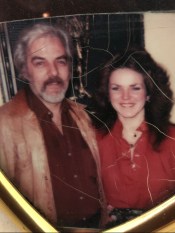
When I was seventeen, my dad took me to a dirt-floored nightclub in a barn on Division Street in Portland Oregon. It was called the ‘D Street Corral’. I remember staring at the entrance, an actual barn with barn-red doors and stacks of hay outside where people stood in line to get in. “Are we goin’ to a rodeo?” I asked. “Cause I don’t like rodeos.”
“You’ll like this one.” Dad said. He lit a filter-less Camel cigarette and we got out of the
car.
Inside it was dark, it looked like a rodeo place with all the stuffed deer, and huge bull horns hanging over the stage.
Hundreds of people gathered at the long bar, small round tables clustered near the stage where a man, a large black man was tuning his guitar, unmindful of the congregating crowd. Dad stepped over to the busy bar and got two bottles of Coke, because they didn’t’ sell alcohol. I remember the waitress, a pretty black-haired girl no more than twenty-three or four, flirting with him. He winked and returned to where I stood. Women and girls, flirted with dad all the time. It rolled off him like water. He’d give that wink, they’d smile, and in that innocent exchange both parties got what they desired, a blameless flirtation. I knew it then, I know it now, though my green-eyed mother never understood that he didn’t invite these flirtations: he was as oblivious to them as that man on stage tuning his guitar.
I wore my jeans, strappy platform shoes, my fringy-suede vest, and a flower-power blouse like I’d seen Julie (Peggy Lipton) on Mod Squad wearing – at seventeen, she was my fashion idol. And of course, my sunglasses stayed on top my head, holding my long hair back, just like Julie’s. On Fridays, I worked for Dad at our downtown Portland shoe shop. Sometimes after work, we stopped somewhere so he could have a quiet drink, me a coke, and maybe have something to eat before going home to a bucket of Kentucky fried chicken, my rambunctious three younger brothers and my mother’s impossible to anticipate, shifting, diet-pill induced moods.
Dad went up to a table right next to the stage where two guys were seated, he leaned down and said something to them, then took out his money clip and handed them a crisp ten-dollar-bill. They stood. At first, I thought they looked angry and that maybe dad was gonna get into a fight.
But then one said, “Your daughter, well…” they looked at me and smiled, “Happy twenty-first birthday.” And they left. We sat at the table right at the edge of the stage. Those peanut shells on the floor kept getting into my cool platform shoes and cutting at my feet. It hurt. I thought, what would Julie do? Yes, I was that corny and tragically trying to be cool at seventeen. Well, Julie would act like nothing was wrong, even if her foot was bleeding. So, I kicked off my shoes and propped my feet on the chair next to me. Dad smiled, we toasted, clinking our bottles together as the lights went down. The crowd hushed, and that large man on stage stepped up to the microphone and didn’t say a word, but the next few seconds I quickly recognized the beginning guitar notes of ‘The Thrill is Gone’. I leaned across the table to my dad who was nodding his head and had a smile on his face like I’d never seen on him before. I almost didn’t’ want to intrude, but then said, “Is that…?”
“Yep.” He said, still nodding, still smiling. “BB King.”
That was the night, the place, the song and the surprising blues-loving man I was with, when I was introduced to the blues.
Later, in my twenties I returned to ‘D Street’ on many Saturday nights to hear bands like Vegas and Paul Revere and the Raiders, because no matter how ‘Julie’ cool I tried to be, my favorites songs were ‘Kicks’ and ‘Indian Reservation.’ We danced our butts off. But there was never a night there more special than the one I spent with dad, sipping a beer and listening to BB King.
TELL your readers a story, don’t leave out the details like rocks in your shoes, smells, sights, sounds and sacred memories.
If you liked this post, please FOLLOW my blog (see sign up at the right) and please share on social media. Thanks, Mindy


Good Critiques Are Essential
Good critique – the opinion of readers and other writers whom you trust – is vital to writers who want to improve their craft. Critique helps a writer make that piece of writing they just birthed, even better, and therefore increasing the odds of publication.
However, critiquing another writer’s work is a delicate, potentially hazardous proposition (to friendships and or family relationships) if you forget a few golden rules. I’ve seen writers receiving critique, drop into despair, eyes water, some even storm out of critique groups and never come back. That serves no one. Keep in mind that often writers tie their entire sense of self worth to their writing. A critique can seem like criticism if not handled carefully. In my beginning years critiques were hard for my thin skin to take. These days a critique is just part of the work, a necessary part, and I’m happy to edit, cut and rewrite to make my work what I want it to be. In other words, I now have thick scaly alligator skin.
Conversely, I’ve seen writers who want ONLY praise, who will not and do not read the craft books, understand the art of writing, and have no intention of doing so. To protect yourself, your time and energy keep this golden rule; DO NOT WASTE YOUR TIME AND ENERGY on any writer who is not working on their writing as hard as you do, or more so.
Writer’s Digest even has a Critique Group survival guide you can check it out here. Additional Golden Rules; Be kind. Be brave. Be thoughtful in your feedback.
No one learns anything if you are too kind, not brave enough, and your feedback is done hastily and is not helpful.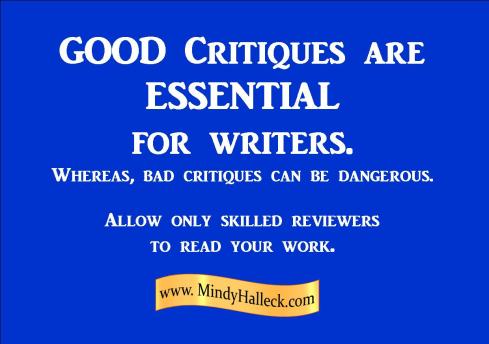
In critiquing, remember these golden rules;
- Critique the writing, not the writer.
- ONLY work with writers who want honest feedback that will genuinely help them improve their work.
- Take time and make an effort so you can offer a critique that is thoughtful and helpful; otherwise, just respectfully decline to do a critique for them.
- Put yourself in the critique receiver’s shoes. EMPATHY is key here.
- Always be brave enough to tell them the truth, in the kindest way possible.
- Take time to consider your feedback and how it may be received, then hopefully both parties come out unscathed, wiser and with mutual respect.
And for those receiving critique;
Not letting writing critiques wound you is easy to say. It necessitates a change of perception and a ton of practice to earn my kind of alligator skin. Constantly remember; your writing is not a reflection of your value as a human being. Keep reminding yourself that a critique is an opportunity for evolution. Keep reiterating to yourself; to become a better, stronger writer will take growing pains, as does all transformation. I remind myself of what Hemingway said, “It’s none of their business that you have to learn how to write. Let them think you were born that way.” Then I take every opportunity, including receiving critiques, to become better at my craft.
Bottom line, it’s your work, your words, your story. Don’t let anyone take that away from you.
Honor Your Writing Time
This morning I responded to a woman who is in a writer’s group that I mentor, about establishing and then protecting her writing time. She wrote to let me know she picked up the book, The Artist Way, that I recommended. I thought I’d share my response since it’s important for us all;
One of the hardest things I had to do (some years back) was transition from being a bread-winner-single-mom career woman, into being a writer, whether paid or not – mostly not. Learning to  honor my writer’s spirit was tough life work. It took me a decade of feeling guilty if I was not making money, or dealing with everyone else’s problems – always putting my writing last. Not that I still don’t have these issues, but what’s different these days is that my writing comes first. My family knows this now. Well, the family that I am close to. Many of them, like the ‘toxic playmates’ in Julia Cameron’s, The Artist Way, are no longer part of my inner circle. My inner circle shrunk at first – illuminating the shallow-thinking-feeling bankers, mortgage experts, finance guru’s and realtors that had populated my soul-sucking career world. But then, as time went on and I changed, embracing my artist self, my inner circle expanded in ways I had never imagined – artist, writers, playwrights, screenwriters, and so on. That was a vital part of honoring myself, of embracing my dreams and transitioning to the other side, to a life I had only ever fantasized about.
Establishing writing time was also a huge part of that. NOW I feel guilty if I don’t write. That’s a complete change.
Remember, as Julia Cameron wrote;
‘Our creative dreams and yearnings come from a divine source. As we move toward our dreams, we move toward our divinity.’
I have lived (and still am living) this journey and am now closer to the other side, the side I NEVER thought I’d transition to. It’s been hard work, but SO worth the journey. I wish you confidence and a spark of divine spirit as you embark on this journey. It’s your life work now, you’ve chosen it, it has chosen you…you can’t not go down this road, because if you do, that’s the path to regret – nobody wants that.
Set a time each day, as we discussed. Stick to it, even if it’s 20 minutes. That 20 minutes is a seed that will grow. Surround yourself with people who believe in and honor your dreams. No One else is allowed in right now, not till your stronger, with feet firmly planted in making your dream come true. Then, like a good meditation session, outside noise can’t penetrate your dream world.
All my best. Mindy
A BIG THANK YOU to Lydia for reminding me how far I’ve come on this path.
Keep writing you all, even if it’s 20 minutes a day. Write on. Cheers, Mindy
This REALLY Irritates me!
I’m posting this here on my blog, as well as I did on #LinkeDin because it really is getting out of control: Every day I get hit up by these scammers on social media, especially LinkeDin asking that I pay them for a review of my #Novel. These dishonest review practices should be against the law. Really chaps me. I’m sharing my response to this girl who is a lawyer wannabe. UGH! I know it may be naive on my part to wonder about lawyers, but still, are Ethics and Morals no longer a requirement?
“””PLEASE do NOT send me a message asking me to pay you to review my novel. I DO NOT pay for reviews. It’s dishonest and should be illegal. I get perfectly good 5starreviews on my own, based on REAL readers and their HONEST opinions. thank you. AUTHORS and READERS, if you agree, please share this post. Thank you. Cheers, MIndy Halleck, Author of the consistently FIVE STAR reviewed novel, Return To Sender https://amzn.to/2wGL9Bp“””””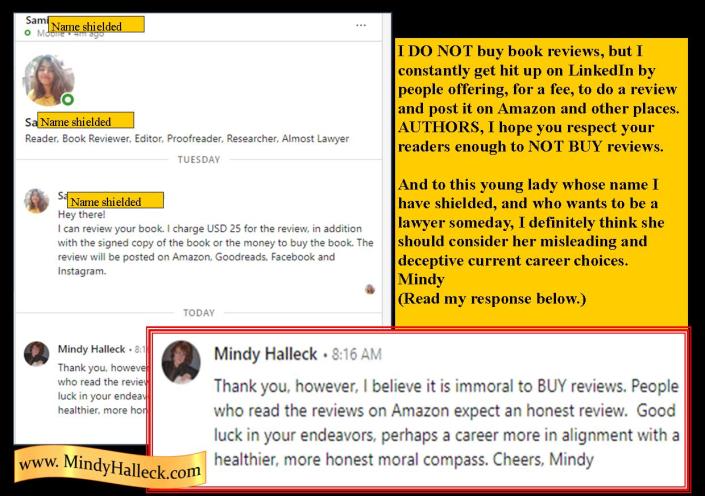
First Pages are Hard Work – Writers Need Super-Powers
Writing first pages is hard work. PERIOD.
The expectations of you as a writer are huge, and the expectations of readers is even HUGER (is that a word? Maybe not, okay…) BIG, big reader expectations start on the first page.
Anyway, it takes a lot of work to get it right. One thing to remember, amongst the gazillion other things you need to remember about first pages, is to ground your reader in some details. Which details depend on your story, theme, and your super-powers as a creative genius?
Your first page should, in some way, set up the general question your novel is asking and answering. And hopefully by the last page you will convey an answer to that question.
Meanwhile, the reader should have some idea about the setting right away. For example, what season is it? Where are the characters? What is the time period/special world/era? What is the mood? The elements you convey quickly in the beginning set the stage for the story to follow. And that my writerly friend, is a lofty quest.
Last week in a writing class, I shared the opening to one of Lauren Groff’s stories, Delicate Edible Birds as an example of a great first page/paragraph. This is not only beautiful writing, but also tells  us a great deal about; location (Paris) mood (dark), era and conflict (WWII) and weather (rain) all in an imagery filled (wings of dark water…street corners as elbows, etc.) poetic style that seduced me as a reader, to continue on. (Read the pretty words in the image to the right.)
A reader should not have to wonder about fundamental questions while trying to slide effortlessly into your story world. This means you’ll have to provide some answers pretty quickly, like on page one.
If you can capture your reader’s curiosity, tickle their emotions, and deliver a character that does the same, then you’ve created a winning first page — one that will engage and mesmerize your audience.
The perfect first page draws readers in from the beginning and tempts them to keep reading. This is your first impression, your chance to hook readers and get them enthusiastic about the story to come. So take the time, use all your creative senses and get it right on page one. It’s not impossible, I promise, and it’s a challenge that’s SO worth it.
Writer Unboxed has a section called “Flog a Pro” where they ask people to read first pages of works by famous authors and then comment on whether or not they were moved to continue. Many say they were not. Reasons include too much detail about the setting or not interested in the characters, but usually the reason was simple—no tension. Reading sites like this is a great way to get some ideas for your own work.
Also, read The First Five Pages, by Noah Lukeman for some great advice on writing your first pages. Good luck.

 Mindy Meyers-Halleck