Fiction Writing, write to heal, survivor
This REALLY Irritates me!
I’m posting this here on my blog, as well as I did on #LinkeDin because it really is getting out of control: Every day I get hit up by these scammers on social media, especially LinkeDin asking that I pay them for a review of my #Novel. These dishonest review practices should be against the law. Really chaps me. I’m sharing my response to this girl who is a lawyer wannabe. UGH! I know it may be naive on my part to wonder about lawyers, but still, are Ethics and Morals no longer a requirement?
“””PLEASE do NOT send me a message asking me to pay you to review my novel. I DO NOT pay for reviews. It’s dishonest and should be illegal. I get perfectly good 5starreviews on my own, based on REAL readers and their HONEST opinions. thank you. AUTHORS and READERS, if you agree, please share this post. Thank you. Cheers, MIndy Halleck, Author of the consistently FIVE STAR reviewed novel, Return To Sender https://amzn.to/2wGL9Bp“””””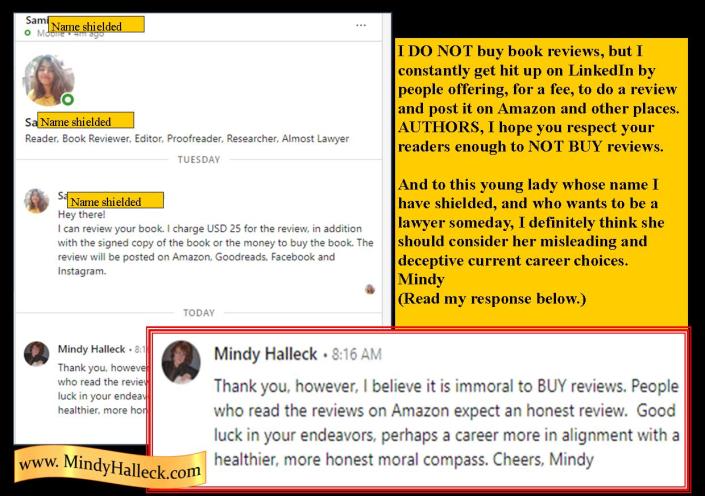
First Pages are Hard Work – Writers Need Super-Powers
Writing first pages is hard work. PERIOD.
The expectations of you as a writer are huge, and the expectations of readers is even HUGER (is that a word? Maybe not, okay…) BIG, big reader expectations start on the first page.
Anyway, it takes a lot of work to get it right. One thing to remember, amongst the gazillion other things you need to remember about first pages, is to ground your reader in some details. Which details depend on your story, theme, and your super-powers as a creative genius?
Your first page should, in some way, set up the general question your novel is asking and answering. And hopefully by the last page you will convey an answer to that question.
Meanwhile, the reader should have some idea about the setting right away. For example, what season is it? Where are the characters? What is the time period/special world/era? What is the mood? The elements you convey quickly in the beginning set the stage for the story to follow. And that my writerly friend, is a lofty quest.
Last week in a writing class, I shared the opening to one of Lauren Groff’s stories, Delicate Edible Birds as an example of a great first page/paragraph. This is not only beautiful writing, but also tells  us a great deal about; location (Paris) mood (dark), era and conflict (WWII) and weather (rain) all in an imagery filled (wings of dark water…street corners as elbows, etc.) poetic style that seduced me as a reader, to continue on. (Read the pretty words in the image to the right.)
A reader should not have to wonder about fundamental questions while trying to slide effortlessly into your story world. This means you’ll have to provide some answers pretty quickly, like on page one.
If you can capture your reader’s curiosity, tickle their emotions, and deliver a character that does the same, then you’ve created a winning first page — one that will engage and mesmerize your audience.
The perfect first page draws readers in from the beginning and tempts them to keep reading. This is your first impression, your chance to hook readers and get them enthusiastic about the story to come. So take the time, use all your creative senses and get it right on page one. It’s not impossible, I promise, and it’s a challenge that’s SO worth it.
Writer Unboxed has a section called “Flog a Pro” where they ask people to read first pages of works by famous authors and then comment on whether or not they were moved to continue. Many say they were not. Reasons include too much detail about the setting or not interested in the characters, but usually the reason was simple—no tension. Reading sites like this is a great way to get some ideas for your own work.
Also, read The First Five Pages, by Noah Lukeman for some great advice on writing your first pages. Good luck.


Writing About Home
A Sense of Home
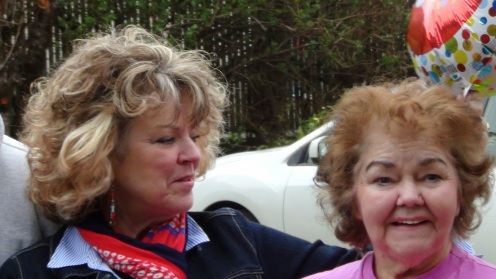
My childhood homes were many, chaos filled and transitory. My mother’s wanderlust disrupted life whenever we found a place to call home. I attended too many schools to remember, learned to disconnect from friends with ease, finally making no friends, because within that ‘ease’ was heartbreak every time I had to say goodbye. Those goodbyes generally occurred every year. That was the timeline: one year. Then mom got itchy feet, sold everything she owned, and move on to a new life, believing the grass is always greener somewhere else. It never was.
These days I jokingly call her the merchant of chaos, but that appellation is a thin veil masking the pain, abandonment and shattered reality of what should have been a refuge. Because of her, the concept of ‘home’ was alien to me; what is home? What and who should be in it?
I recall vividly, when I was ten years old, returning from school one day to a garage sale on the front lawn, all our furniture being sold, my bedroom set included. I loved that bedroom set with a French provincial white four poster bed and matching vanity. It was mine. How could she sell it?
That day, my bedroom furniture went off with an old woman. The red tail lights of her truck at the corner of Stanton Street, blinked, then turned onto 35th and disappeared. A deep root of resentment set in my bones that day. I knew with the fading of those tail lights we would soon move, leave our house, school, friends and start over, again.
Over the next three years my parent’s fights grew to legendary proportions; arrests, house fires, crashed cars, broken bones, or them disappearing for days on end, leaving me to tend my three younger brothers. I learned home was not a safe place, not a place where I could get attached to anything, or trust those whom I should have been able to trust the most. And though they loved us, my brothers and me, we were forgotten in their war. Dad slipped into alcoholism and mom, her bizarre gypsy ways, including, but not limited to giving things away with no regard for what was paid for those things or what they meant to the holder. Twice we ended up in a house with no furniture. Dad would buy new, she’d get mad and sell it all again. Dad finally disappeared with the last furniture sale.
I left ‘home’ at thirteen, then moved back because I had nowhere to go. At sixteen I left again, for good. I couch-surfed, lived in a car, a church basement and was blessed by a cousin who took me in.
It took forty years of roaming humanity’s desert to finally find a safe place to call home. Now, I have one with gardens, water view and a loving husband who swears (after our last move) we will never move again–music to my ears. We lived in our last house over a decade and we will stay in this one till we’re too old to go up the stairs, then it’s a condo, we’ve decided. I thrive in the normalcy of his steadfast plans. I’ve learned home is more than a house that can be sold, left and abandoned, it’s who is in that house that makes it a sanctuary. Home is no longer an alien concept to me. Home is my unwavering husband, no matter where we live.
My wander-lusting ‘merchant of chaos’ mother resents my normalcy and mocks me with her teen-angst voice whenever we argue. We argue a lot. Thankfully I’ve come to understand she is not a well person. She is an eternally rebellious and trapped teenager who wants to leave home, and I am the parent. To her any belongings, children, husbands or homes are shackles and must be banished, escaped and left behind.
For example, last year after we moved her into a fairly posh retirement residence, they had a Halloween dance at a neighboring rec-center. After not speaking to me for a week because I left her in a ‘home’, she called and asked if I’d drive her to the party. When I arrived she descended the stairs slowly so I could take in the full view of her costume; a black and white striped prison uniform with a chain belt.
She got into my car without a word, sat smiling and looking forward, her point made.
I shook my head, started the engine and said, “Do we need to stop somewhere to pick up a ball and chain?”
Now, that one year mark has hit. She’s serving her sentence in the ‘home’ but is planning an escape. She has one friend left who can drive (during the day) and they think they’re going on a road trip, you know to where that grass is greener, and apparently where men have hair and teeth. They are in their eighties and need naps about every two hours. I don’t think they’ll get far, I think that hair and teeth will be fake, and I know the grass won’t be greener.
We have told her if she tries to leave this safe haven we will never help her find one again. She knows we mean it this time. And though she has these little rebellions, I don’t think she will actually leave the retirement center where they feed, medicate, entertain and allow her the freedom to come and go with no strings. I think she’s finally grown up enough to recognize the need for a home.
Our mother, regardless of antics loves us deeply in her own dysfunctional way, and in that love is our sense of humor, humility, and yes, finally a sense of familial home.
Did You Know a Denouement is a Literary Device?
No matter how long you’ve been a writer, how many craft books you’ve read, studied and made part of your writerly DNA, a refresher never hurts. I firmly believe that if you choose to be a writer you’ve chosen a life-long apprenticeship. And if you stop learning, changing and growing, your writing will likely go stale, fall flat on the page and die there unnoticed.
So, I get excited when I learn something new – which in my life is pretty much every day.
Yesterday, at the EPIC Writer’s Group that I often lead, we had a guest speaker, Elena Hartwell author of the Eddie Shoes Mystery Series. Elena spoke to our group about story structure. In her talk she used a term I had heard but didn’t really appreciate. The word was Denouement.
A quick Google search gives us a definition; ‘Denouement is a literary device that can be defined as the resolution of the issue of a complicated plot in fiction. The majority of examples of denouement show the resolution in the final part or chapter, often in an epilogue. Denouement is usually driven by the climax.’
The difference between Resolution and Denouement is that Resolution is when the main problem or conflict is resolved. The Denouement is the very ending.

In class we used the example of one of my favorite ‘I’m home sick today’ movies, Notting Hill. You know, boy (Hugh Grant) gets girl (Julia Roberts), loses girl, girl wants boy back. Boy is an idiot and loses girl again. Then finally BOY GETS GIRL. Anyway, if you know the movie you remember the scene at the very end where Hugh Grant sits on a bench in the park and Julia Roberts lovingly reclines her pregnant self at his side. This revealing of the happy couple in their happy world is the characters in their new world order. This is the Denouement, this is him (our hero) after his hero’s journey, returned to his normal world, but forever changed.
I love learning new writing terms, how to apply them, and where they belong in the story structure.
I’m looking forward to Elena Hartwell’s 4 hour workshop in May. Class description; How to Build Tension with Objectives, Obstacles and Stakes
Stories require tension. From memoir to mystery, sci-fi to romance, comedy or tragedy, tension keeps readers turning pages with a need to know what happens next. So what can writers do to increase tension? One way is to focus on characters’ wants and needs. Investing each character with something they want, putting something in the way, and having high stakes for the outcome, makes stories compelling. Clear objectives, obstacles, and stakes make your stories the kind readers can’t put down. This workshop will help writers of all levels put these concepts into practice.
May 18th 2019
EPIC Writer’s Workshop 9am – 1 pm $70.00 for EPIC members $85.00 for non-members – Frances Anderson Center 700 Main St. Edmonds, WA.
Join Elena Hartwell for a 4 hour writing workshop, How to Build Tension with Objectives, Obstacles and Stakes.
Space is limited, so sign up TODAY at www.EpicGroupWriters.com

About Elena; In addition to her work as a novelist, Elena teaches writing workshops. She also does developmental editing, working one-on-one with authors on novels, short stories, and plays. If you’re interested in working with Elena on a project, please contact her.
When she’s not writing or coaching, her favorite place to be is at the farm with her horses, Jasper and Radar, or at her home, on the middle fork of the Snoqualmie River in North Bend, Washington, with her husband, their dog, Polar, and their cats, Coal Train and Luna, aka, “the other cat upstairs.” Elena holds a B.A. from the University of San Diego, a M.Ed. from the University of Washington, Tacoma, and a Ph.D. from the University of Georgia.
https://www.elenahartwell.com/
(Photo credit: Mark Perlstein)
What’s Milieu Got To Do With Story?
By the 1970s the now trendy and oh-so-cool Portland Oregon #PDX was known as the ‘porn capital’ of the northwest. Deep Throat seemed to play on a loop at ‘certain’ local theaters, and drugs -pink hearts, cross-tops and pot – were handed out like candy.
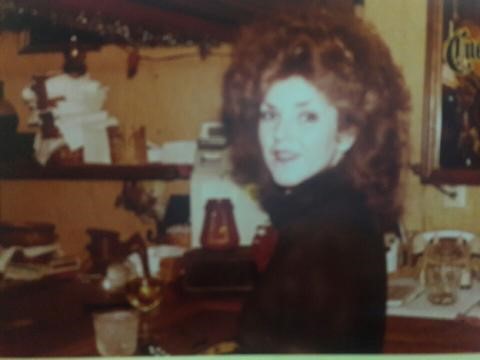
Like me, Portland in the 1960s and 70s was struggling to come of age. It was populated by people deeply wounded by WWII, weary from war, ever-suspicious of the Korean War, and ambivalent over the Vietnam War. Everyone was touched by warfare in some way – many sought escape.
Somewhere between 1967 and 1978 a great tide changed in Portland, at least in my life. Portland went from free-living-loving hippies in the parks, to disco in the clubs, drugs on every corner, and in every shadowy crevice of the city. From free love to cash-for-sex and porno, from dancing in the streets to the throb-throb-throbbing pulse of Donna Summer’s voice in the cocaine-laden disco nightclubs. Portland changed, and as I went from guileless teen into my awakening twenties, from innocently dancing in the parks, into the dark world of nightclubs, so did the landscape of my life, and the city I called home.
My current WIP (work in progress) is a collection of stories that draws upon that complex and layered backdrop. Why does that matter? That backdrop, setting or milieu, resonates with the theme of the stories, provides a mood and a frame of reference for my coming-of-age themes of ‘lost innocence, lost power, and soul death’.
When creating a narrative – fiction or non-fiction – it’s vital to have an in-depth understanding of your story world. Think about the cultural mores of a Jane Austen novel. Those quiet sufferings and tight reins on emotion in a polite society, would never work in today’s world.
The milieu or setting of a story consist of both the time and physical location within a storyline, either nonfiction or fiction. As a literary component, the setting helps introduce the main background and mood for a story. Essentials of setting may include culture, geography, and the historical period – it pains me to say the 1970s is now historical, but it is. It’s official, I’m old. Along with the character, theme, plot and style, setting is considered one of the fundamental components of fiction.
If you are interested in reading about Portland’s sleazy background, check out author Phil Sanford’s books, Rose City Vice and Portland Confidential.
 Mindy Meyers-Halleck