female archetypes
Autumn Poem
I’ve just returned from our annual trek to Cannon Beach, Oregon. While there, I pondered Autumn and all the many spiritual and physical meanings and consequences of the season.
‘Autumn’ was the monthly prompt from our Edmond’s poetry group leader, author, Gerald Bigelow. I wrote several poems sitting on my deck overlooking Haystack Rock. I love to write #poetry while on vacation. It gives my brain a break from novel #writing and the relentless search for an agent.
I’ll share this short one with you, shockingly titled Autumn.




Autumn
Thoughts
Traverse
Beachy memories
Lost to long days
––now shortened
In search of a warm hearth ablaze
To reminisce on sun-splashed
Nostalgias
––lingering
Only to melt against life’s bonfire
Of lost days.
Autumn leaves above my head
Turn
Swirl
Soar
On the wind
And fall like summer memories
To their final feathery bed.
2 responses to “Autumn Poem”


Dementia–The Cradle of Twilight
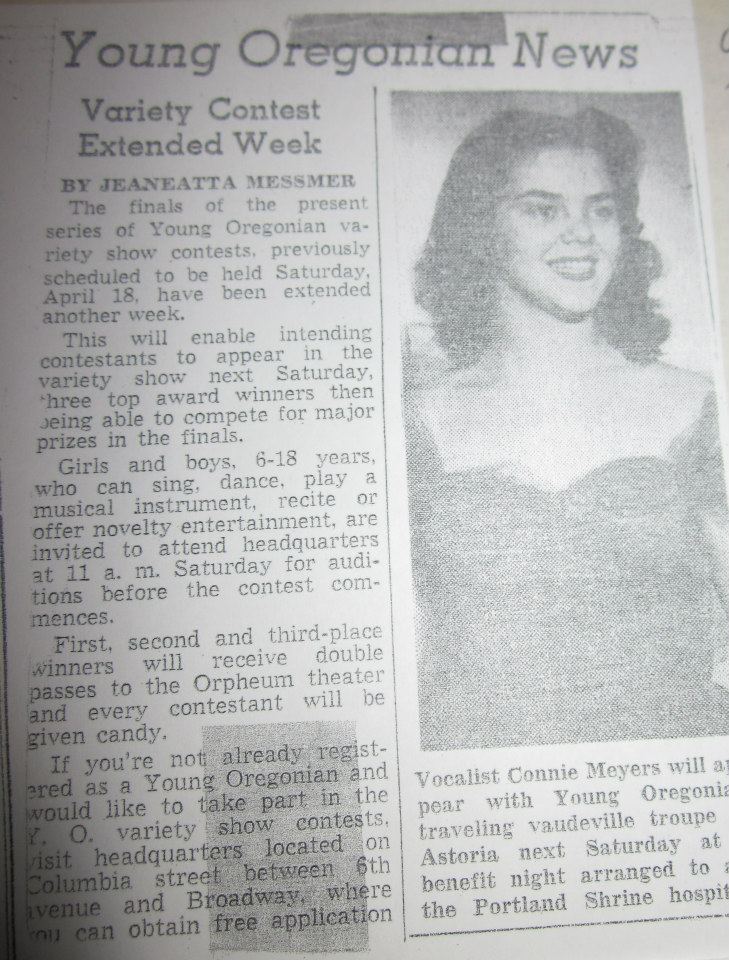
My mom, Connie Meyers was a beauty queen who was never comfortable in her own skin.
She constantly changed hair color, her waistline (yoyo dieting), fashion, lipstick, and persistently adored or hated herself in the mirror. She never fully wanted to be in this world. The story goes that she died once or twice when she was a child. She saw heaven and did not want to return to this earthly realm. She said so all my life. And once her beloved mother, my grandma Ollie May, died, she only wanted to be with her in that celestial kingdom she saw as a child. Then a couple of her sisters died, then a couple good friends, and all she wanted was to peel off her skin and go with them. Mom was my real-life Selkie.
This poem, Cradle of Twilight was published today Sundays Poet’s Corner of My Edmond’s News. I wrote it during the months of my mom’s descent into dementia. She finally slipped into the deep blue three years ago.
Applying the Celtic myths of our Scottish Irish ancestry was this daughter’s way of making sense of, and peace with her mother’s journey in a life she hated, and her longing to return ….
Cradle of Twilight
Mindy Meyers-Halleck
At the edge of midnight
she rises from bed,
steps outside her coastal cottage
wearing her nightdress
barefooted––
shaved head.
As her soul lays ruined against the rocks,
she breathes in the briny algae drifting on the breeze,
and hears the eternal song of the seas––
the crash of cresting waves, clicking of dolphins, flurry of bubbles,
as seaweed sways, shuffling side-to-side in the ever-shifting tide.
As the webbing between her fingertips
twitches
itches
grows,
she knows––
her seal skin is forming …
eternity knocks.
Soon she’ll return to the briny deep,
swim, frolic with the Selkies,
––drift upon the waves in deep, deep sleep,
with her sisters of the sea.
As her aching body prepares for transition––
exchange of human skin for glossy black Selkie seal––
beneath the silver light of the moon,
she cries seven tears
into the sea,
the price of re-admission to her natural milieu––
She’s been gone too many years,
she misses the sweet taste of salt
and the sky reflected on water,
the soothing blue, blue, blue.
From the shore she sings a melodic tune that echoes across the waves.
Those enchanted echoes
whispers on the wind
a bridge that
crosses one mystical realm to the other––
calling to them
calling her home.
This earthbound world has been painful at times––
abandonment, loneliness, loss, grief––
things the human body can’t release …
instead,
it aches, opines and enshrines
pronounces itself dead.
But love has been a treasure healing earthly wounds.
Love, divine as the silken skin of her sisters of the sea,
has made her short journey a spree
of wonder.
Worth leaving the embrace of blue waters
… Temporarily.
But now she cries seven tears,
and calls to her family of the deep––
Will you come for me soon?
She is ready for the waves,
the gently rocking,
a cradle of twilight sleep.
Come for me soon …
She awaits divine transcendence beneath the silvery moon.
*************
Below are photos of Mom in her heyday and then in the early 2000s in Edmonds, WA.



Transcending—Art into Poetry
During a recent workshop with the poet Susan Rich, on Ekphrastic poetry––which is poetry that explores art––at La Conner’s gallery/museum, MoNA, I became entranced with a painting, which I’ll share in a minute. Susan inspired us to find a painting or piece of art in the gallery, and using a rhetorical device known as ekphrasis, engage with the painting, drawing, sculpture, or other mode of visual art.
The term ekphrastic (also spelled ecphrastic) originates from a Greek expression for description. The earliest ekphrastic poems were vivid accounts of real or imagined scenes when writers in ancient Greece aspired to transform the visual into the verbal. Later poets pushed beyond depiction to reflect on deeper meanings. Today, the word ekphrastic can refer to any literary response to a non-literary work.
The painting that grabbed my attention and heart was The Longhouse by Helmi Juvonen, a gift from Wesley Wehr.
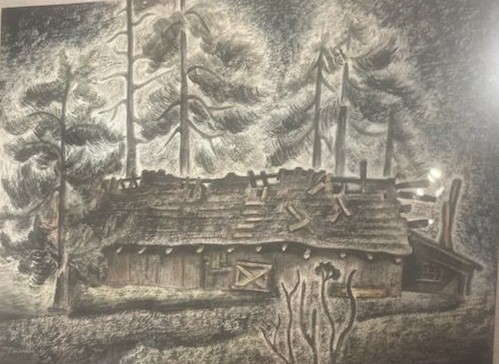
Helmi Dagmar Juvonen (January 17, 1903 – October 17, 1985) was born to Finnish immigrants (Helmi is Finnish for Pearl) and became an American artist associated with the artists of the Northwest School, and was active in the Seattle, Washington area.
She attended Queen Anne High School, and after graduating, worked various art and design-related jobs while studying illustration, portraiture, and life drawing with private teachers. In 1929 she received a scholarship to Cornish College of the Arts, where she studied illustration with Walter Reese, puppetry with Richard Odlin, and lithography with Emilio Amero. You can read more about her illustrious career here.
Sadly, Helmi was diagnosed with schizophrenia (manic-depression), and was committed to a mental institution in Elma, Washington, where she spent the final 26 years of her life. There, she was visited by artists and supporters, who facilitated wide recognition for her work, during her lifetime through many art museum exhibitions.

Helmi transcended boundaries
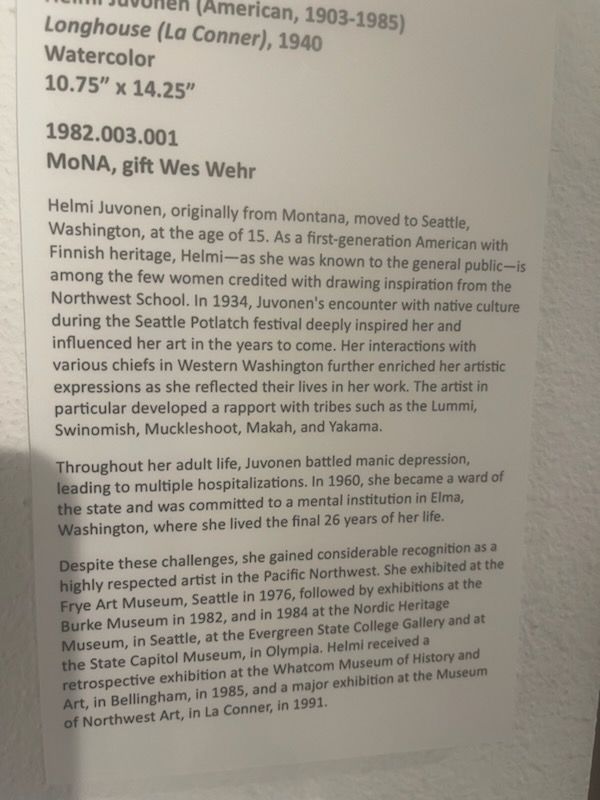
Native American culture cultivated Helmi’s creative spirit and empowered her to transcend the boundaries of ordinary life, poverty, and decades in a mental asylum. Her interest in identifying the origins of human culture, especially as it addressed the dichotomies of good and evil, led her to investigate these themes in diverse spiritual traditions – Judeo-Christian, Tibetan Buddhism, and the Baha’i faith.
And in the painting that captured me so completely, I sensed something beyond the brokenness of the exterior. Combined with my (limited) knowledge of native folklore from the Oregon Coast––gleaned while researching my novel Return To Sender––and reading a bit about the Lummi Nation (Pacific Northwest myths, I wrote the essence of what I felt and saw in this piece of art.
My poem from that day, which is also published on the MoNA website, is titled, Dancing with the Dead. Please visit MoNA’s site and explore all the poems produced that day. I have a 2nd poem on their site titled, Shadow Dance.
Dancing with the Dead
By Mindy Meyers-Halleck


Her house is ill,
they said.
Unhinged shutters,
band aids on the roof,
boards as exposed as skeleton bones,
a crooked door that’s lost its will,
and a roofline of sagging skin.
Her house is ill,
and it allows no one out,
and no one in.

The native peoples
said of their treasured mad woman
with skin white as pearl
that she is
broken in the head.
––but, that sacred wound,
They said,
allows darkness to seep in.
And in those spirit-filled shadows
she dances with the dead.

It took her a lifetime,
to embrace the brokenness in her head––
––her dark shadow sister who never saw the sun––
A sister coiled in nocturnal corners, dreaming of
wolves, trees, and danger
she was never able to outrun.

The trees that surround her house are
not quite alive
not quite dead,
they haunt the yard
––redolent with tears and blood of the fallen
sister who never saw the sun.
She is broken in the head,
they said.

In those mist shrouded trees
she sees
The Keeper of Drowned Souls.
His green long-fingered hand,
spindly as spider legs,
beckons her to follow
deep, deeper into the hollow.

The Keeper of Drowned Souls exists
transitory between the human world and the phantom world
he tells her,
her dark sister who coils like the snake
inside her house,
is condemned to endless hunger, agony, wandering and sin.
Because her house is ill,
it allows no one out,
yet he wants in.

She is broken in the head,
they said.
She observes ethereal phantoms,
and dances with the dead.
From Maiden to Monster, Female Archetypes
I recently rewatched PENNY DREADFUL, City of Angels
“All mankind needs to be the monster he truly is, is being told he can.” Magda (Natalie Dormer) states in the first episode of Penny Dreadful: City of Angels. I’d forgotten how captivating this character (and her portrayal by Dormer) was when I first watched it a few years back (2020). This female character is complex, brilliant, and breathtaking, sometimes quite literally.
Sowing seeds of discord, Magda’s plan to start a race war is to whisper in the ears of men she perceives as weak. Men might be the target of this shapeshifting demon, but she uses the face of Archetypal women to enact her vision. Traditional roles, including mother, secretary, and maid, dominate the 1938 Los Angeles setting, but the heavy dose of feminine archetypes is wielded as a weapon within Magda’s grand design.
At her core she is Isis: The Destroyer: A steadfast woman who never sways from her life’s mission but sees things in black and white; she is a firm believer in “the ends justify the means” as she masterfully slithers from maiden to monster. If you’re writing women, this (first season) is a must see. Magda is nothing like women in the Penny Dreadful novels of old. She’s new and horrifying.

Follow me on my Instagram page @Femarchetype for more on Female Archetypes.
 Mindy Meyers-Halleck
Leave a comment