Between Nightlife and Sunrise — Memoir Writing
You know what I miss? I miss those 2:00 AM hours in the 1970s when I’d get home from my job as a bartender and

Me, 1970s
immerse myself in my nightly ritual. I’d turn on my Garrrard turn table, unsleeve an album, usually Aretha Franklin’s ‘You Make Me Feel Like a Natural Woman’ – you thought that was a Carol King song didn’t you? Well, she wrote it but it was originally written for Aretha. Anyway, then I’d pour a glass of Chardonnay, light a cigarette – yes, I smoked then – sit back and listen to the crackle of the diamond needle as it tripped the tracks, scraping the vinyl waves in search of her soulful words. I miss that sound.
“Lookin’ out on the mornin’ rain I used to feel so uninspired….facin’ another day made me feel so tired….you are the key to my peace of mind….when my soul was in the lost and found….” Lines like that stirred my damaged heart and blue soul. I’d take off my hoop earrings, slip off my platform shoes, prop my feet up, inhale what then was the seductive taste and aroma of cigarette smoke, drink in her voice, those heartrending words, the comforting wine and commiserate with my female counterparts in the stillness of my two room flat – often in front of my art easel; an oil painting I could never finish staring back at me.
The line, ‘when my soul was in the lost and found’ hit home because that was how I felt. There was no one making me feel like a natural woman, but I longed for that, for him, whoever he would be. The 1970s were a lonely time full of heartache, foxy nightlife and cunning men, shadows that when the sun rose withered back into the cracks from which they came. There was nothing in my day life worth the morning sun, so it was in those wee hours when I examined my soul so lost in the hope of being found.
Aretha’s song touched me when she sang it, and it affected me again when Carol King serenaded every American woman with her own words that became an anthem of sorts for my generation.
As much as I felt my life was dead end when I was a wise twenty-three year old, just knowing someone out there understood and had gone through what I was going through lifted my spirits in those lonesome hours between nightlife and sunrise.
Some thirty-years later I was thrilled to see Carole King live, at a shareholders meeting for a company in which I had purchased stock with a small amount of hard earned money. She sang, of course, You Make Me Feel Like A Natural Woman, and as I sat there, a happily married woman and a (minor, with a capital M) shareholder, I smiled at my road traveled and was again warmed by the words that helped me keep moving forward and guided to me to the discovery of the strong ‘natural woman’ within. It was a moment for me, a 20-20 hindsight thing where I felt like lighting a cigarette (though I hadn’t smoked in thirty-plus-years), pouring a glass of wine and hearing a real vinyl recording of my timeless anthem.
Instead, I settled for a latte and an autograph.
If I were to write a memoir, that would be what they call a ‘memoir moment’. What are your memoir moments? What were you doing? What were the smells, sounds, feelings? Go way back in time and pick one. Then write it, honestly and with all senses. Be brave. Expose yourself. Happy writing.
My Author Interview with Edmonds Community College
Cool, my #Author / #writing instructor #interview w/@EdmondsCC is out, have a looksee…
“Vision Boards to Enhance Your Writing AND Social Media Presence,” Mindy Halleck, June 21st, 2017 from Visual Media Services, EdCC on Vimeo.
What is an author platform and where do you get one?
 Author platform can be challenging to explain, partly because definitions can vary. But by far the simplest description is: your capacity to sell books because of who you are or who you can reach.
What activities build author platform?
Platform building requires consistent, continuing effort over the course of a writer’s career. It also means making enhancements in extending your network, on-line and in person. It’s about making waves that entice other people to you—not about pleading with others to pay attention.
The following list is not extensive, but helps give you an idea of how to cultivate a platform.
Publish or distribute quality work in outlets you want to be associated with and that your target audience reads.
Create a portfolio of work on your own platform—e.g., blog, e-mail newsletter, social network, podcast, video, digital downloads, etc—that gathers quality followers or a community of people who are interested in what you have to say. Have patience because this takes time.
Decide which Social Media Platform is best for you, use it and be consistent, relevant and entertaining. And remember, social media alone does NOT create platform unless you’re a Kardashian, and even they get out and do public appearances.
Speak at and or attend events where you meet new people and extend your network of like-minded peers and audience members.
Connect with influencers* and or peers on a new project and or discover creative ways to extend your visibility. *An influencers is a person or group possessing the ability to influence the behavior or opinions of others, via large SM following, podcast audience, etc.
Discover personalized ways to engage with and develop your target audience, whether through content, events, online marketing/promotion, etc.
Platform building is unique to each author
Platform building is a gradual process that must be organic and will be different for every author. There is no checklist you can use to develop a platform, because it will always be governed by:
Your distinct story and or message – Your unique strengths and abilities – Your target readership
I will be teaching a workshop July 15th at Edmonds Community College wherein part of the day will be spent on social media. If you’re local, join us here
If you liked this, please TWEET it out for heaven’s sake! 
What’s Your Hero’s Journey?
Types of Heroes
(Adapted from Chris Vogler, 1999, pp. 41–44)
What kind of hero are you writing?
Willing, active, gung-ho heroes: (Tarzan, King Arthur, Luke Skywalker, Wonder-woman)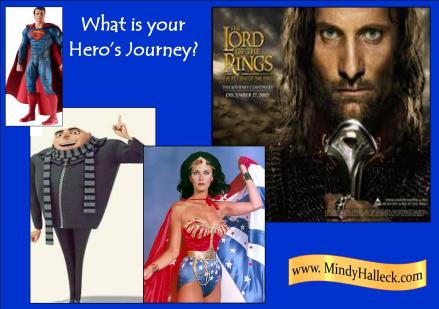
- committed to the adventure
- without doubts
- always bravely going ahead
- self-motivated
Unwilling heroes: (Frodo Baggins, Spiderman, Han Solo)
- full of doubts
- hesitant
- passive
- needing to be motivated or pushed into the adventure by an outside force
- usually change at some point and become committed to the adventure
Anti-heroes: (Billy the Kid, Jack Sparo, “Bride” from Kill Bill)
- specialised kind of hero
- may be outlaws or villains from the point of view of society
- audience is in sympathy with them
- they may win in the end over society’s corruption
- rebels
Tragic heroes: (Darth Vader, Brutus)
- flawed heroes
- never overcome their inner demons
- brought down and destroyed by inner demons
- may be charming
- their flaw wins in the end
Group-oriented heroes: (Nemo, Simba)
- are a part of society at the beginning
- journey takes them to unknown land far from home
- separate from group – have lone adventure in the wilderness away from the group
which they eventually rejoin
Loner heroes: (Indiana Jones, Incredible Hulk)
- story begins with hero apart from society
- natural habitat is the wilderness
- natural state is solitude
- journey is one of re-entry into the group, an adventure within the group, then a return to
isolation
Catalyst heroes: (Teacher from Dead Poets Society, any mentor)
- central figures who act heroically
- don’t change much themselves
- main function is to bring about change in others
If you liked this please tweet it out, join me at @MindyHalleck
To receive your FREE 12 Page Writer’s Craft Kit today
sign up for the Lit-Liaiz Newsletter HERE.
Creating Characters Who Dance on Fire
Often when contemplating the creation of fictional characters – what makes them do what they do, or what makes them who they truly are – I’ll watch movies or read books about damaged people, because (as we all (writers) should know) flawless characters are boring and no human makes it very far in life unblemished.
Today I watched the first movie that received high tributes for one of my favorite actors, Tom Hardy who can play  anything because of the depths he is willing to go into the human psyche. Anyway, the movie is Stuart: A Life Backwards. The synopsis: A writer takes a backwards look at the life of his unlikely friend Stuart, a homeless alcoholic who experienced a traumatic event in his childhood.

I laughed, I cried and I came out of the movie with even more (if possible) admiration for my favorite actor. This movie was based on a true story. And even though it’s impossible to put mere words to the human experience that rises above verse, we as writers can aspire to hold a mirror up to our characters and reflect what we see in the world – and if we delve into our writerly craft – what they might see in the world. This character Stuart was charismatic and abhorrent at the same time – abhorrent because it can be difficult to look at the things we find disturbing; homelessness, disease, drug addiction, violence and fear. Tom Hardy danced like a skilled ballerina around each of these issues of the human condition. His (character’s) loud abrasive communications with the world were a beautiful soul-sick opera.
My head is spinning with ideas on how to write more compelling characters, characters who can dance on fire and whose hearts sing to the universe for mercy.
Oh, and if you haven’t been watching the new Tom Hardy TV series titled, Taboo (2017) you’re really missing out on some GREAT characters. Well, I’m off to create.
 Mindy Meyers-Halleck