fiction writing
Pain Is A Great Teacher
I haven’t blogged in one year. WOW! As a long-time blogger, that’s a huge break.
In January I had a devastating fall in my home. I broke my shoulder, damaged the ulnar nerve in my elbow, sustained a concussion, bruises from head to toe, sprained and fractured my wrist, lost all use of my right arm and hand––of course I’m right-handed. Of course! ––and was bedridden for over 3 months. It was a traumatic injury that I am still, and as of writing this on September 1st 2024, going to physical therapy twice a week to regain full use of my hand. It’s painful, but worth it.
During my bedridden days, my husband had to feed me. I HATED being a helpless burden.
Anyways … I couldn’t even hold my phone, imagine that! I was very upset about losing writing time. And though the prospect of working on my full-length novel projects was too overwhelming for my concussed brain, I had to do something. Also, at that point, I could only use my forefinger on my bruised left hand to press a button, or anything else. My right hand was completely useless and in pain. The picture here shows how my arm swelled up and had black bruises from shoulder to fingertips. It looks more like an elephant trunk than a human arm. But human it was, and it was mine.
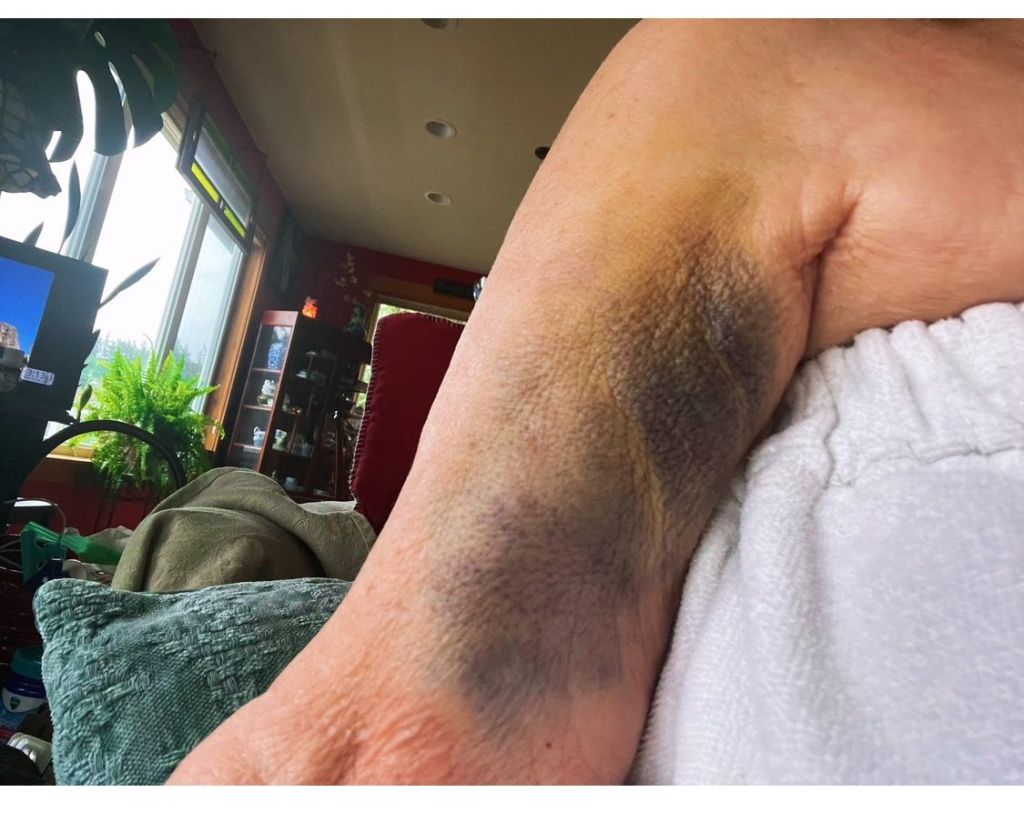
I was getting a bit depressed (pain meds didn’t help) about not writing, which I also realized was projecting my fear of having just almost died, onto the writing that would never be finished. My fate was linked with my trauma and created a profoundly sad state of mind. And trust me, that’s not a good foundation for healing––but only I could lift my spirits.
Unable to use my right hand––any movement reduced me to agony and tears––I managed to prop my phone on a pillow next to me and turn on my voice technology. I spoke into the phone and texted myself bits and pieces of story ideas and poems, trying to reawaken and spark my groggy brain cells. Though some days I could only work this way for 5-10 minutes without dropping into complete exhaustion, it saved me. I felt a sense of purpose and was able to stay in touch with my writing spirit, which is everything. Feeling a sense of purpose is vital in healing from anything.
During those months I managed to write several poems. I sent them to my e-mail (via text) to edit and format later when I was sure I would be able to type again. Later came five months later in early June. I formatted them and organized a manuscript of poetry, along with professional art, and voila! A small book of poetry was born from my trauma and a desperate desire to heal—heart, body, mind, and soul.
I am now querying that book to publishers. I am pleased to say that one poem has just been published in the Penn Journal of Arts and Sciences Literary journal.
Please give it a read, my poem is titled, Maiden, Mother, Crone https://www.upennjournalarts.org/writing/maiden-mother-crone-c44gn-nwrbj
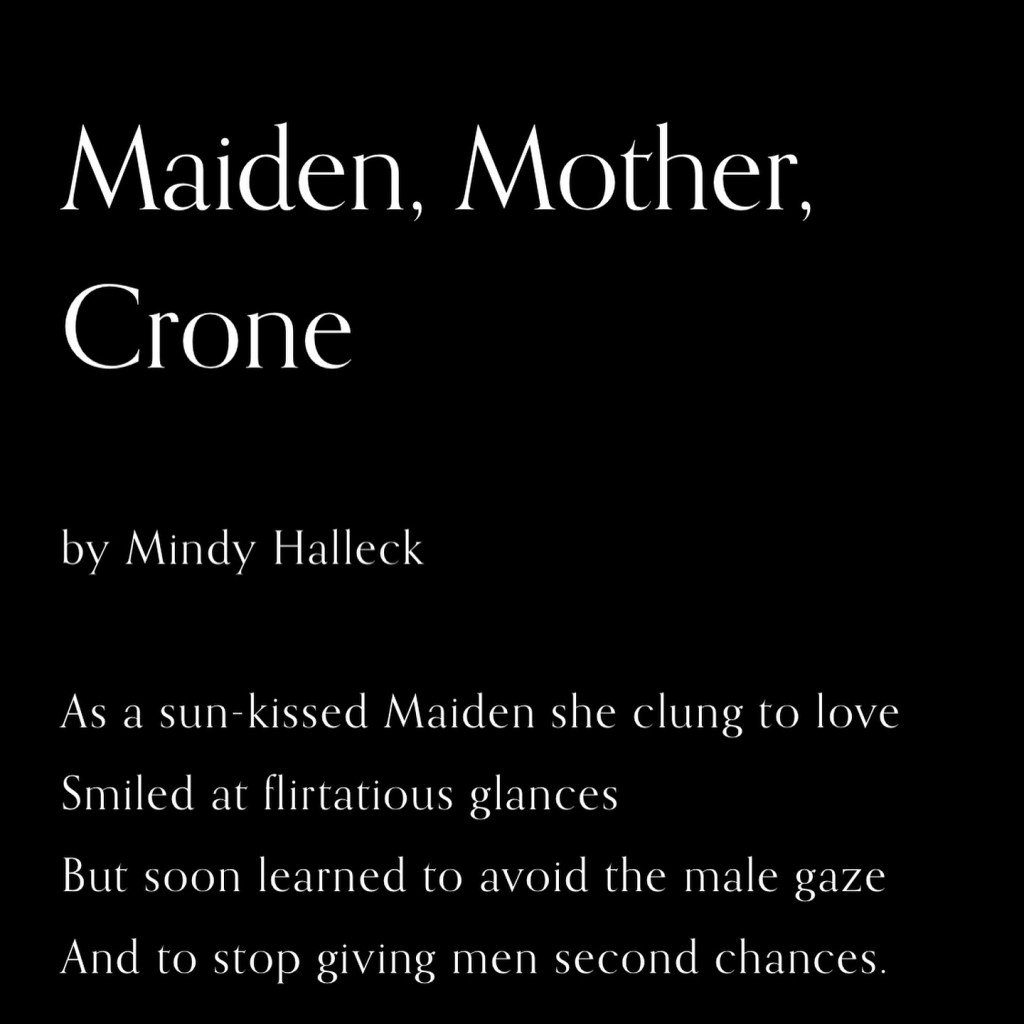
They also did a lovely interview with me, take a look at my featured profile Mindy Halleck — Penn Journal of Arts and Sciences (upennjournalarts.org)
Another poem titled, Unraveling was published in the Edmonds News, Poet’s Corner: Unraveling – My Edmonds News Though that poem was written before my fall.
What has this taught me about life? Well, pain is one of the greatest teachers we have. We learn a lot about ourselves, our resolve, our desire to heal, and mental as well as physical fortitude. I’ve lived through cancer, and had numerous other things happen to me but this injury has been the most traumatic, soul shaking experience. What it did was focus me in a way I had not been focused since my brothers died two years ago. It reminded me that time is of the essence and if I wanted to get anything done before I too, check out, I’d better get busy.

It also made me focus on my intentions, for example, what do I want to say in my work? I am concentrating on writing about the lives of women—ordinary and extraordinary alike—and the choices they make. I desire to delve into stories and poems that are instructional from my Crone-age perspective and encouraging for younger generations, passing on the wisdom of this old female warrior who has gone before. Pain has taught me to embrace my unique voice on these topics. Afterall, no one else has my lived experience or my voice.
I’m back to life now, gardening (short stints), and back to writing and querying. Oh, and smiling, I am definitely back to smiling.
Don’t wait for pain to be your teacher. What are you writing, why are you writing, and how can you tap into your unique voice?


From Maiden to Monster, Female Archetypes
I recently rewatched PENNY DREADFUL, City of Angels
“All mankind needs to be the monster he truly is, is being told he can.” Magda (Natalie Dormer) states in the first episode of Penny Dreadful: City of Angels. I’d forgotten how captivating this character (and her portrayal by Dormer) was when I first watched it a few years back (2020). This female character is complex, brilliant, and breathtaking, sometimes quite literally.
Sowing seeds of discord, Magda’s plan to start a race war is to whisper in the ears of men she perceives as weak. Men might be the target of this shapeshifting demon, but she uses the face of Archetypal women to enact her vision. Traditional roles, including mother, secretary, and maid, dominate the 1938 Los Angeles setting, but the heavy dose of feminine archetypes is wielded as a weapon within Magda’s grand design.
At her core she is Isis: The Destroyer: A steadfast woman who never sways from her life’s mission but sees things in black and white; she is a firm believer in “the ends justify the means” as she masterfully slithers from maiden to monster. If you’re writing women, this (first season) is a must see. Magda is nothing like women in the Penny Dreadful novels of old. She’s new and horrifying.

Follow me on my Instagram page @Femarchetype for more on Female Archetypes.
Meet Mindy (Halleck) Meyers
Sometimes we open a wound not to watch it bleed, but to allow it to heal.
I just returned from a writer’s retreat wherein I was asked why I don’t write about the story seeds of the novel I’m currently crafting. That question opened a wound I didn’t realize I had. Bear with me ….
First, I’ll start with why I will now write under a pen name, a Nom de plume, or literary double, however you coin the term, it’s my new/old name. I’ll be writing under my mother’s name, Meyers, for many reasons. But the one HUGE reason is to honor my grandfather Frank Meyers who wanted to be a published author but never was. And the other, to honor my Jewish roots, denied to us because in the 1930s grandpa (non-religious) moved my mom and her siblings from the south to the west coast and immediately put them in Catholic schools. He also allowed my Irish/Scottish grandma to take them to Baptist churches: determined that his children would not experience the discrimination he did. His own father was murdered in front of him in New York, simply for his name. Meyers. So, I staunchly take the moniker and move it forward, in a time when our country seems to want to move backward.
Why does this matter now? The holocaust should never be forgotten. I’ve just completed one novel with a holocaust survivor as a protagonist and am now working on my next novel which––though not a war or holocaust story––is populated with holocaust survivor stories. Clearly, the holocaust may not be my story to tell, but I had a ringside seat to its aftermath. And it is in that 1950s and 1960s aftermath where my story seeds took root.
Last week at that writer’s retreat, a New York agent questioned my name, and then asked if I was a non-Jewish author writing unauthentically about the Jewish experience. I explained that though I grew up in a Christian household, my biological father was Jewish, and my mother’s father (Grandpa Frank’s) mother and father were Jewish. She asked what their family name was. I told her, and she exclaimed, I can sell a Mindy Meyers writing stories about victims of the holocaust. It rhymes, and it suits the stories you’re telling. Besides you have genealogy.
At first, I recoiled at the idea of a marketing platform based on something I thought I wasn’t. And deeper yet, genealogy is a wound of mine. Being born under the shadow of scandal, the feeling of being ‘illegitimate’ has always bloodied the waters. So, that night, I returned to my hotel room and cried, deeply, irrationally, as if mourning the departed or resurrecting a scarred over wound.
Then, about 3:00 am I realized the reverse was true; Mindy Meyers is who I’ve been all along. It was the first name on my birth certificate, before dad rushed in and married mom to give me legitimacy.
Heck, even at the Oregonian Newspaper in the 1950s, where grandpa worked, I had a name tag that read, Mindy ‘Minnie Mouse’ Meyers––Minnie Mouse was my very official nickname. So, making a LONG story short, Minnie Mouse is reclaiming her identity. Mindy Meyers is now my Nom de plume.
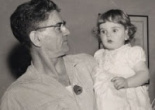
That was the first step toward telling my long-held stories. I’ll be blogging about them in the coming months. For now, I’ll share that in the early 1960s, when I was nine years old, I worked with my dad at his shoe repair shop in northwest Portland. I stood on a milk cate at the 1940s cash register, took in money and gave change. I was the official greeter, purveyor of cookies and tea for ladies who waited for dad’s popular 5-minute-heels, and I held down the fort when dad took a smoke break.
Dad’s shoe repair was in a building long rumored to be haunted. To nine-year-old me, it was a place of magic and mystical beings. At that time PDX was very international, multi-cultural, and filled with politics and fear of strangers, Nazis hiding in the shadows. There were Hasidic Jews with long black side curls called Payos, thick black beards and black hats, such a contrast to my ex-Air Force dad with his short hair and clean shaved face. There were palm-reading Gypsies, and the infamous King of the Gypsies who walked about the city with two large men behind him (bodyguards). He’d bring dad a cigar and have a laugh while those men waited at the door, keeping anyone else from entering. And then, the very cranky Rabbi who liked arguing with Dad about politics. And SO many other colorful people.
Occasionally it was my job to deliver shoes to a few of the customers who lived across the street in the (then) Nortonia Hotel. One was a woman who I thought was very shy. I’d knock on the door, listen as she unlocked seven locks, then crack the door open to where I could see only her eye and half her face. “Who are you?” she asked every time. “Oskar’s daughter,” I’d hold up the brown paper bag. “I have your shoes.” She’d quickly shut the door. I’d wait. She’d return with a fresh baked raspberry Rugelach cookie. To this day my favorite. She’d hand me the cookie that smelled of sweet burnt sugar and warm raspberry––through the narrow passage of the barely opened door. And then she’d say, “Sit, child eats’ das cookie while I inspect das shoes.” I would slide down the wall, sit on the floor and eat my cookie. She never looked at the shoes. Instead, she smiled the saddest smile I’d ever seen, while she watched me eat. When I finished, she handed me a napkin, “Vwipe face. Now hurry child, go to your papa, tell him all is goot. Do not talks to das strangers. Go now, hurry.” I’d rush down the hall while behind me the sounds of a bolting door, clanking chains, and the locking of seven locks echoed against my fleeing footsteps.

There were five women, holocaust survivors who lived in those apartments. My dad explained to nine-year-old me, that someone had hurt them in the war, and now they were a little frightened of people, and that they were lonely, so to spend time with them. Be kind, he’d said. Listen to their stories. So, I did.
As a child I grew to believe that like dad’s building, these people were haunted.
Now that hotel is the lovely Mark Spencer Hotel where I stay when I’m in Portland. To me, it’s a sacred place. I feel these women there. And I am comforted by their presence. I always grab a Rugalach at a local bakery to take to my room where despite the beautiful furnishings, I sit on the floor leaning against a wall, eating and remembering. Who’s haunted now ….

In the coming stories, blog posts, and novels, I honor these people who imprinted so deeply on nine through seventeen-year-old me, that they have become my ghosts, the spirits who walk with me. I’m honored to create stories around the essence of who they were to this child now woman who aches with their sorrow, and yet smiles when remembering their unique humor. In bringing them out of the shadows, I’m giving them an identity, while at the same time, reclaiming mine. In honoring them, through my storytelling, I am healing an old wound, mine and theirs.
Female Archetypes
Lately, in a desire to understand why I write certain types of female characters and yet struggle with writing others, I’ve launched into an in-depth examination of female Archetypes. One thing I have realized is that I don’t struggle to write the archetypes that are most consistent in my own nature, Artemis and Hestia, but do struggle with Persephone and anything Aphrodite-related. So it’s important to not simply mirror my own character aspects but to reach beyond them and write female characters whose archetypes might be foreign to me. I do believe all the archetypes are alive in my psyche at any given time, which is the case with most of us. And though we are not limited to our core archetype, it is generally the one that drives us. Especially when under stress. That’s a great thing to know when creating fictional characters.
I’m currently looking at the Greek Goddesses (archetypes):
The seven goddesses:
- Athena, goddess of wisdom.
- Artemis, goddess of the hunt.
- Hestia, goddess of the hearth.
- Persephone, goddess of the underworld.
- Demeter, goddess of grain and agriculture.
- Hera, goddess of marriage.
- Aphrodite, goddess of love.
I’ll be sharing my female archetypes educational journey here on my blog, and also on my Instagram account at @Femarchetype, so please follow me there.

If you liked it, please share @MindyHalleck
Tweet
Leave a comment
What Inspires a Story?
I often am asked what #inspired my #awardwinning #shortstory on #Writersdigest? It’s complicated, but the short answer is it was a neighbor from my childhood. Her son was mentally disabled: sometimes when he tried to play with us, he accidentally hurt us; a broken arm, a bruised rib cage, a bloodied nose. He was 16 with the mind of a 4 year old and the strength of a line-backer. We were all under 10 years old. It was the early 1960s, people used the ugly word “retard” and mocked and teased him. But he wanted so desperately to be friends, so we played with him. He reminded me of #BooRadley #tokillamockingbird…I’ve never forgotten him. You can #read my tragic #story here on #WritersDigest where it won a #fiction contest.
Sometimes inspiration comes from the littlest, most insignificant things, like an image or a smell. I saw a man sitting in a boat on a lake once, he was slumped, holding his hat in his hands. I knew instinctively he was grieving. I felt it in my bones. It inspired a scene in my novel, Return to Sender, where the protagonist, Theo, sees the father of a young girl who was found murdered, sitting in a boat in the middle of the river. I wrote him exactly as I saw that man in the boat.
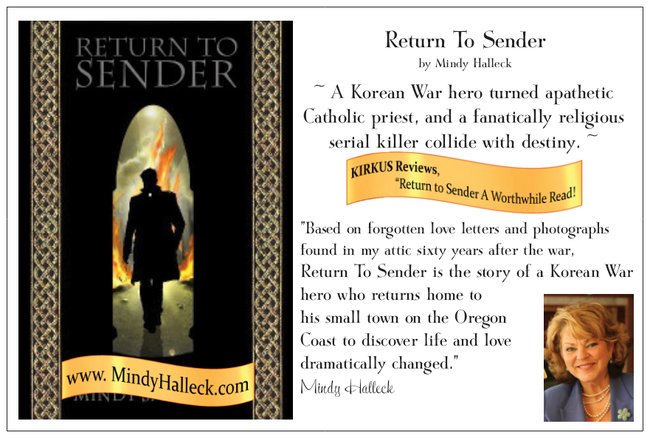
Return to Sender was initially inspired by a box of letters, love letters from during the Korean War that I found in my attic sixty years after the war.
I take notes on everything that tugs at my heart, my curiosity, or my sense of justice, or injustice. I save them and use them as story world material. There’s something new everyday, either from my daily beach walk or something I saw on tv. I never know where inspiration will be found, but I do know where to go when in search of, and for me that’s an art museum—where one of my greatest joys in life is to sit on a bench in the presence of great art, and write, whether it’s the Portland Art Museum, Amsterdam’s Rijksmuseum or the Louvre’ in Paris, that’s as good as it gets when seeking inspiration.
 Mindy Meyers-Halleck
Leave a comment