Fiction Writing, write to heal, survivor
Structuring Short Stories
Regardless whether you’re a Plantser (an Outliner) or a Pantser (one who writes by the seat of their pants)—I’m a combo, a PLAN-ANTSER…HA! Did I just coin a term?—Anyway, no matter how you approach your short (or long) story, I recommend a basic story structure, like the classic, 3-Act. Aristotle wrote that a tragedy, (a type of plot) should be divided into parts: a beginning, a middle, and an end. He also believed that the events of the 3-part-plot must somehow relate to one another as being either necessary or credible. And so, we have the 3-Act-Structure.

The 3-Act Story Structure (Thank you Aristotle)
TIP: Before you design your structure consider first, what is the profound change you want your character to experience by the end? Why? Because the answer to that question should fuel your story through all 3-acts, delivering theme, character arc, and a satisfying resolution.
Act 1: BEGINNING – Set up. Introduce your characters; establish the story world, theme and tone. Here, your protagonist should be called to action, due to some sort of crisis point (inciting incident) that shakes up their ordinary world and launches them into a new one.
Act 2: MIDDLE – Conflict. Avoid saggy middles by plunging the protagonist and allies deeper into even more difficulties and obstacles. Often things get worse and they need to re-group and get back on their feet, before things can get better.

Act 3: END – Resolution. This is where your main character(s) figures things out, and actually develops the courage, or a plan to face their demons, slay their dragons, and solve their problems. As a writer, you should always write towards a satisfying ending. That’s why I started with the TIP of knowing what you want your character to experience, their ARC, by the story’s end.
This is a typical story structure is a good starting point if you want to write short stories. I also do this for novel length stories as well. Smart guy, that Aristotle, he sure knew what he was talking about.
And here’s a little you tube (6 minutes) with additional ideas on structuring short stories, starting with Anne Lamont’s acronym ABDCE


Short Stories and the CoronaVirus
Hey Scribes! This video is for you. So sorry we had to cancel our weekly Edmonds writing group today, but we don’t have any protocol or real understanding of the Coronavirus just yet, so, an abundance of caution seemed to be wise. ANYWAY, on to what we were going to cover today; #Shortstories. In this clip that I made in my cozy nook at home, I’ve read a couple examples of the beginning of short stories for things to ponder as you imagine your own. We’ll dig in next week. Meanwhile the stories I’ve chosen as my examples today are Lauren Groff’s Delicate Edible Birds, and Jo Ann Beard’s, The Tomb of Wrestling. I love them both.
SO, hopefully my short message will keep you in the writing groove because next week we’re going to start looking at short stories. And in case you are wondering, a short story is; Traditional, 1500-5000 wds — Flash Fiction, 500-1000 wds — Micro Fiction, 5-350 wds Remember,
“For sale: baby shoes, never worn.” Maybe by Hemingway, but nobody is sure.
Anyway, here’s my video, it’s about 10 minutes.
Rebellious Female Characters
Harvey Weinstein is GUILTY!!! Duh! But YEY!
Beyond the Hero’s Journey, there’s no denying it, rebellious female characters—from Katniss Everdeen to Olive Kitteridge—dominate literary fiction.
Following the countless cases of male victimization and sexual harassment in the headlines lately, it seems that fictional heroines reflect a mood of defiance with the world that men have programmed and ruled. There’s a new movement of modern-day heroines who are damaged, flawed or even unapologetically ridiculous. Some who still seek romance, sure, but others who just as self-assuredly seek a one-night stand with or without a man. And while she may change in the progression of the story, divulging strengths and tactics that astonish us, a woman’s conformity is no longer required.
Carl Jung’s archetypes are the building blocks of the story world. In Chris Vogler’s book, The Writers Journey: Mythic Structure for Writers, he teaches about the vital use of archetypes in storytelling; the hero, the mentor, the threshold guardian and so on….
Beyond those central standards are the 8 FEMALE ARCHETYPES writers should be paying close attention to.
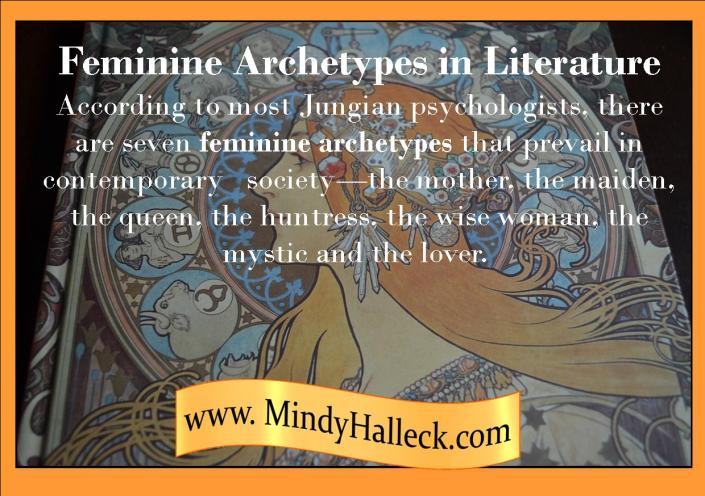
According to Jungian psychologists, there are 7 feminine archetypes prevailing in modern society—the Mother, the Maiden, the Queen, the Huntress, the Wise Woman, the Mystic and the Lover, to which I add, the emergent, Mermaid.
The Mermaid Archetype is emerging in today’s troubled world. This seductive, wild, Mermaid represents the feminine power of water—strong, loving, nurturing, self-indulgent and gorgeous, yet at the same time untamable, belligerent and outrageously independent—picture Aquaman’s mermaid mother, played by Nicole Kidman. She is a shapeshifter, a turbulent temptress, representative of both the loving abundant features of the ocean and the raw immense power of the seas and its undercurrents. Love and adore her, yes, but don’t piss her off!
These newly resurrected and empowered archetypes are used in modern day literature, on screen, and they now permeate society far beyond the secret whisperings of Jane Austen, to the anger of Lizbeth Salander, to the controlled madness of Gone Girl, and the literal Mermaid in Aquaman.
Archetypes have a language all their own. In the DNA of that unspoken language we often find the words and images essential for communicating our (personal and fictional) otherwise indescribable inner worlds (thoughts and feelings). Inner and outer continuously seek one another, and it is the sacred labor of the writer (or artist) to bring the two into artistic relationship; to reach deep into the hearts and minds of readers and provoke a rich and enlightening story experience.
Writers should be having fun with these emerging archetypes and should be delving DEEP into their imaginations to tap these mythic like women, Amazons or Mystics, for the multi-layered storytelling of which the world hungers.
Oh, and did I mention, Harvey Weinstein is GUILTY!!!
If you liked this please post it on your Facebook, Instagram or Twitter page. Thanks.
Leave a reply or comment below. Thank you.
The Seven Dwarves of Writing – Silencing The Shadow-Self
Julia Cameron, author of The Artist’s Way, suggests that when we write our morning (or mourning) pages we should think of it as taking our shadow-self out for coffee. I love that!
We must get all the cantankerous, crabby, complaining stuff out in order to clear the path for what’s to come.
As a fiction writer, I find this to be an invaluable tool. Often it’s tough to get my brain to stop obsessing about the day; my grocery list, meetings, phone calls, arguments, what time does my husband get home, and for goodness sakes I need to call my mom, and etc.…the day at hand. I need to get through those twenty-foot reeds to get to the creative side of my brain, and sometimes I just can’t get through them on my own. That’s where the morning pages come in. Writing LONGHAND, which means no typing, gives you access to your subconscious mind in a way that does not happen when using a computer. In addition, it’s good for your brain, science says so. Don’t believe me, read this Forbes article.
I like to think of my shadow self as the seven dwarfs; Grumpy, Dopey, Doc, Happy, Bashful, Sneezy and Sleepy.
The seven dwarfs symbolize different aspects of our self (dark and light sides).
Happy embraces the universe from a delighted state of mind and emotions.
Sneezy repels or banishes anything unwholesome that comes from the world.
Bashful helps us return to our secluded cosmos, giving us respite from the world.
Grumpy is the part of us that struggles against light.
Doc leads the parade in whining and complaining. Doc is the intellectual side that keeps us in touch with spiteful reality.
Sleepy is the turn-the-power-off apparatus within us, enabling us to take a break from chaos, to shut down when we need time alone.
Then there’s Dopey who embodies our naïve, innocent nature wonderfully unaware of the perils whirling around us.
Once I’ve written my way through those disruptive dwarfs, and they are all down for their nap, I start my writing journey and when I’m lucky I often arrive on Snow White’s doorstep—my inner writer.
Snow White symbolizes the purity and innocence that exists within us all. She beautifies the scenery of our mind, our thoughts, and feelings. She echoes our innermost radiance and reveals our most imaginative intelligence.
From this safe creative space—dwarves hushed—I can create.
And once I’ve started creating, I delve deeper into the stories I’m trying to tell. It’s only then, when the dwarfs are quiet, and Snow White is safe, that I can access my even darker self and craft an antagonist, aspiring to one like Snow White’s Queen.
The Queen—Snow White’s antagonist—represents our inner demons, the untamed ego, greed and the desire of self-gratifying pursuits. The Queen is the false (image) of self—the truest representation of a shadow-self.
Anyway, for me to arrive at a place where I can write a protagonist and an antagonist worth exploring, I need to silence the voices inside my head—That’s tongue-in-cheek, people. I do not really hear voices in my head. Just workin’ an analogy here—That means those annoying dwarves must take a nap. They have to behave, be quiet, and let me write.
Therefore, I allow them to have their say first, like toddlers; once I’ve listened to their wants, needs and complaints, they can go down for nap. QUIET TIME!

Moreover, for me, one way to achieve that goal is through morning pages, afternoon pages, writing in my car, or maybe sitting in a cafe in Florence writing my morning pages while my husband climbs the Duomo.
Keep writing everyone. Silence those dwarves, but let them play on occasion.
Is It Sacrilege to Not Adore To Kill a Mockingbird?
I know this is sacrilege, to speak against To Kill a Mockingbird, but speak I must; First, like everyone else of my generation I loved the movie, liked the book and the story lives on in my childhood  DNA. However, now in the 21st century it should not be overlooked that To Kill a Mockingbird was written by the alabaster-skinned, Harper Lee, a privileged daughter of the Old South.
When I ask writers what their favorite books are, many raise their hands and say, “To Kill a Mockingbird”, to which everyone in the room nods as if to say Amen, can I get a witness! Oops! That’s my Baptist upbringing oozing out… Anyway, then I ask, “When did you last read it?” Inevitably the answer is, “In grade school.” So (I ask) “How NOW is that one of your favorite books when you read it 5 decades ago?”
When I go further into discussion of the book, the story, even the mistakes and typos, everything (except Lee’s style, which is beautiful) they can’t seem to recall much beyond the moral lesson—that take away that caused a generation to take a passive pause—And then they recall Atticus, Boo and Scout, because they are part of our mythos now.
Anyway, you gotta wonder; is loving TKM considered as American as apple pie and ‘can I get a witness’???? Is having issues with it as sacrilege as burning the red, white and blue?
Toni Morrison once dismissed the novel as a “white savior story”, except that Atticus failed to save Tom Robinson. I agree.
To me as a writer, and now as an adult reader, the devastating flaw in Lee’s creation of Atticus is his passiveness and acceptance of rampant, murderous racism as the status quo. As the designer  of his character (the author) rather than having him assigned by the court to defend Tom Robinson, I would have had him insist on serving as the innocent man’s lawyer—not because it’s his occupation but because it’s his duty. This assertion would have energized him and the story. He tells Scout, “Every lawyer gets at least one case in his lifetime that affects him personally. This one’s mine, I guess.” Could he be more passive and unaffected? Could his moral compass be more limp-noodled? Tom Robinson’s damnation by the jury should have ripped the very fabric of Atticus Finch to shreds. But it didn’t because at his core, he too, was a racist, he expected it all along and just went through the motions, with a ‘that’s just the way things are’ attitude. And it’s that attitude that brings us back to the inescapable white woman sensibilities of the author.
Oh sure, Atticus was passively valiant when he stood on the steps of the jail blocking the rope totting white mob from reaching Tom Robinson—but that kind of bravery lacked fortitude and conviction, he was just doing his job, an empty gesture.
However, I think the typical American who revers that book would rather not consider the apathy, laziness, and lack of moral conviction of Atticus Finch. Rather, they indulge in the cute voice of a little girl named Scout who spoon-feeds her girlish moral observations in a way that is not too uncomfortable to digest.
TKM doesn’t ask us to challenge our scruples (like Huck Finn did) no, it allows us to just sit back and be charmed by that little girl, so satisfied by the decency of her father.
Loving and extolling Mockingbird eases our self-blame, and in doing so, absolves us of accountability. It feels good, it feels right, to cherish this novel—AMEN! It feels like it’s what we’re supposed to do. It seduces by attaching itself to our nostalgia and then by satiating our flaccid conscience like the junk food on which we mindlessly indulge. Yep, as long as there are Atticus Finches in the world, someone will step up and take charge, and you yourself can remain in your reclining chair, popcorn in hand watching movies that make you feel like you’ve agreed with the moral thing to do instead of getting up and doing it. We Americans prefer our morality boiled down into easy bite size titbits, and so the lax-a-daisy one-liner-ethics of Mockingbird were and remain appetizing for millions.
Aside from TKM’s Black/African-American stereotypes, of which I am not qualified (as a white woman) to discuss with the fervor they deserve, there are other toxic messages. As writers, we have the potential to send messages, intentional or not, good and bad, via our stories, that are more far-reaching than we imagine.
For example, Imagine that you are an African-American seventh-grade boy in Mississippi today, and are asked to read TKM. Then imagine that it reinforces your haunting suspicion that you are treated differently because of the color of your skin, and that you’ll never get a fair trial if you are suspected of something, like Tom Robinson.
Or, you’re an underprivileged, white seventh-grade girl in Anywhere USA today, asked to read TKM. Then, sadly, you are raped, but after reading that book and digesting other social observations, you stay quiet, believing that people don’t believe girls who say they’ve been raped, like the book says, everyone should have doubted Mayella Ewell.
I could go on and on about how toxic the messages of TKM are, or the changes that have not occurred these 50 some years later, but don’t worry, I won’t. What I will say is that if you are a writer, then please create all your characters (primary and supporting) with more verve and vigor than the limp noodled morally ambiguous Atticus Finch.
In addition, when you’re in a writing group or class and you’re asked, “What are your favorite books” at least have read said books in the last decade. When a writing instructor asks you that question, she/he is asking you what/who influences your writing and the stories you tell. They are also asking you why those influences have stayed with you, what’s evocative about them, why do they matter??? So, when people tell me TKM is their favorite book I invite them to re-read it now and then let’s talk. So far, no takers.
Climbing down off my soapbox now. Scattered Rant is over.
 Mindy Meyers-Halleck