family
Mama Told Me Not To Come
Yesterday, while writing in a coffee shop, a stranger decided to join me. Despite my suggestive glance at the room full of unoccupied tables, she plopped down at mine. “You’re a writer,” she said. And then she proceeded to interview me about the who, what, when, and where that inspired my newly completed (not yet published) novel…. I got over my annoyance and had an interesting conversation, which ultimately inspired this blog post and future posts. I explained to my curious new friend ….
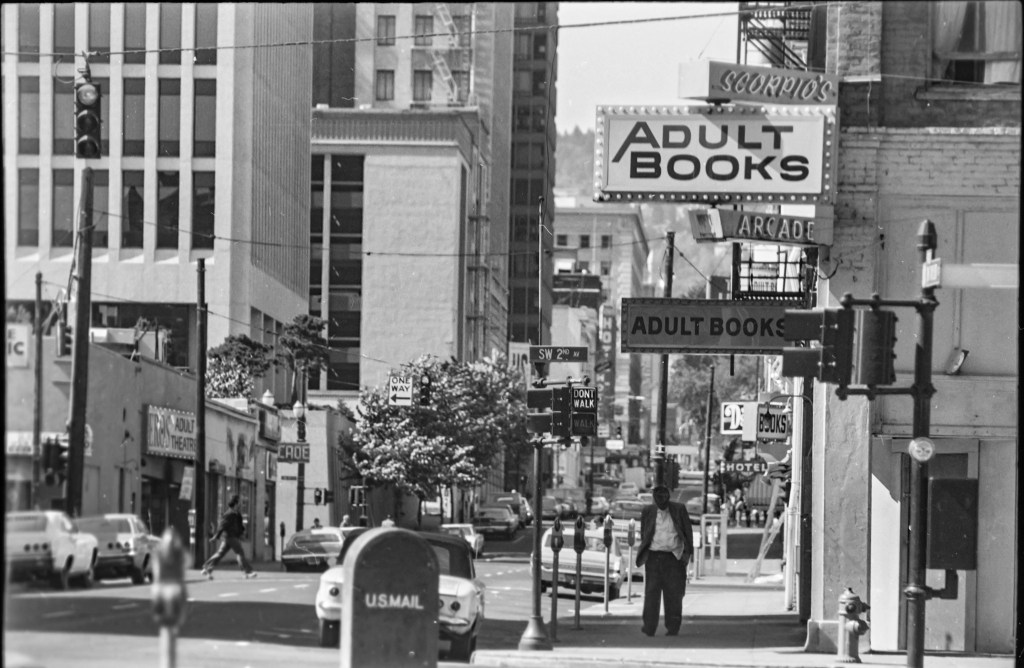
In 1970s, Portland, Oregon, when stagflation met disco-mania, Portlanders seeking liberation from urban blight, lights out orders, and ambushed pipe dreams turned to sexploitation. Mary’s Club, which features prominently in my newly completed novel, and other strip joints packed in customers. X-rated theaters and bookstores of the ADULT sort exploded around the city.
It was a boom era fueled by relaxed obscenity regulations that led to porn palaces and live performances that ruled the neon landscape. Ultimately, The Oregonian Newspaper, where my grandfather worked, named Portland “the pornography capital of the West Coast.”
Religious cults, Vietnam protesters, and abortion rights activists heralded signs on every street.
The day before my fifteenth birthday, Grandpa pulled me aside at the Oregonian. “A lot of things aren’t making it into the paper,” he said in a solemn tone. “We got crooked cops, racketeers, editors on the take,” he whispered. “Pretty girls like you are in danger.”
He explained in one wide-ranging account how girls my age were easy prey, often collateral damage in a metropolis run by the mob. And how Portland’s corrupt politicians had earned a new moniker for The City of Roses; the vice capital of the northwest. Police corruption extended further than pacifying Teamsters on the docks; it was citywide. The thriving narcotics trade enticed officers to look the other way while their palms were greased and young girls vanished from the streets.
Grandpa never spoke to me about such shocking (to my naive sensibilities) issues. So, I listened.
Planted deep within grandpa’s warning that day were the seeds of my novel, Beyond This Wicked Realm to follow some fifty years later. For which I am seeking representation.
Grandpa made sure I had a bus pass, a library card, and books; the classics on which he expected a verbal book report. In his way, he was making sure his teenage granddaughter was too busy to go looking for trouble. Nonetheless, trouble was around every corner looking for her.
After school, a couple of days a week I worked for my dad in downtown Portland, just a few blocks from the Oregonian. I rode the bus into the city past businesses with handwritten signs in dark windows (victims of the governor’s lights-out orders), gas stations with NO GAS signs at the curb, hippies sleeping on park benches, and the yeasty smell of the Henry Weinhard Brewery that permeated everything. I leaned my head against the bus window and studied the girls walking up and down Broadway and Burnside. Some were my age, even younger; black fishnet stockings, black raccoon eyes, and faux fur cropped sweaters, sashaying down the streets, unsteady on their platform shoes. At ten in the morning, they already looked like they had been out partying and drinking all night. Maybe they had. I didn’t know. My grandma called them the lost girls. All I knew was that I never wanted to get lost.
One day when I got off the bus, as I hurried through a group of shouting Vietnam War protestors, a man grabbed me. He had an Afro the size of a beach ball, wore a long black leather coat, and dark glasses. He towered over me. At first, I thought he was one of the Black Panthers, though they normally weren’t in that part of the city. I was terrified. I didn’t speak.
Then he let go of my arm and said, “Hey foxy mama, you a stone fox.” He looked me up and down.
My eyes burned with tears, but I stood paralyzed.
“We could make some moolah,” he said, rubbing his fingers together.
But then, a woman who looked to be my mom’s age slammed his head with her protest sign and shouted, “PIMP! Leave that child alone.” When she did that, a group of protesters ran over to us, shouting, “Police … PIMP!”
That woman turned to me and said, “Honey, you should run now.”
Like Forest Gump, I bolted and ran all the way from 3rd and Washington to 11th, without looking back or stopping for traffic. People honked and shouted, but I didn’t care. I ran to the safety of my dad’s shoe repair shop on 11th. I never told Dad why I was out of breath and crying that day. He gave me a cup of tea and suggested I go read my book in the back of the shop for a while. He no doubt figured it was ‘that time of the month.’ It wasn’t.
It was the first time I was ‘approached’ by a pimp, but it wouldn’t be the last. They were on every corner trying to recruit girls for strip clubs, and worse, much worse. One day, when I left the Multnomah Library on 10th street, carrying my homework books, a man in a black car at the curb offered me three hundred dollars––in today’s money that’s over $2000.00–– to dance in a cage that would be hanging from a ceiling in a local nightclub. I backed away, turned, and ran like that protestor woman told me to do. I wasn’t going to freeze and cry again. I ran.
Being a teenage girl in 1970s Portland was like being a gazelle pursued on an open tundra to the soundtrack of Three Dog Night’s, Mama Told Me (Not to Come). I learned to run, hide, seek shelter, and NEVER talk to men in parked cars at the curb.
I had a few safe havens, good people around me, shelter, and some good sense handed to me by my family. I survived, but many didn’t.
I wrote this novel for them, the lost girls, those who didn’t make it out and those who did make it through the darkness to the other side.
This is the environment for my current novel, titled Beyond This Wicked Realm–In 1973, four women—a Holocaust survivor, a mobster’s daughter, a drug dealer’s abused girlfriend, and a lady-scholar turned drifter—form an unlikely sisterhood in a fight for survival against Portland’s illicit porn and drug trades.
That highlights some of the backdrop for my novel. In an upcoming post I will share my characters, women I’ve grown to love, mentors I wish I’d had, and lost girls I knew.
What’s Mold Got To Do With Politics?
Right now, I am staying in a hotel, a nice hotel, but still, away from my home, my husband, and dog. Mold was discovered in our attic and the removal, repair, and roof replacement has become a major ordeal. With my compromised immune system, I can’t be around the mold or the abatement spraying. So, here I am in a rainy coastal town 25 minutes from my house, with a fireplace and a view of the water––I know, poor me.

You’d think I’d be delving into writing more than I am, but I feel anxious and unfocussed like someone’s tearing my home apart in the middle of winter, and I’m not there to protect it. I know my precious doggo is scared and missing my cuddles, my husband is managing things as best he can from his home office––and maybe he’s missing my cuddles too. Anyway, it’d be better if I were there in person dealing with the contractors, instead of by phone.
Distractions like this tend to silence my muse. Stress is always a writing disruption, but this feels more like a psychic disturbance. Does tearing the shielding roof off my home and ripping the protective insulation out of my attic have spiritual significance to me?
In these troubling times of chaos and tearing our political agencies apart, leaving us exposed and vulnerable to the elements, I can’t help but wonder if that’s the true source of my soul-deep sense of unnerving disorder.
Even with mold in our attic we wouldn’t burn the house down. No, we eradicate and repair, because it is otherwise a great house. That’s what I feel should be done with our democracy, it’s a great house with some rot that should be eliminated. Instead, the house is being burnt down, and we are left exposed and in danger of all looming storms. And they are looming.
To ease my unease I’m taking walks, writing this in a coffee shop, and meditating on my life’s blessings that were once only impossible dreams.
So now, on the eve of our country’s nightmare, I count the blessings of dreams come true and feel empowered to do things once thought impossible: like being 70 years old and trying to muster my inner 17-year-old revolutionary, again––and sadly, to fight for the same things as before.
For me, participating in politics other than voting, attending city meetings, and door-knocking for a few politicians––and once, in the 1970s being quasi-arrested for protesting the Vietnam War, and demanding women’s rights, including abortion rights––has been random participation.
My husband says I’m too political. My grandson says I’m not right enough, and my granddaughter says I’m not left enough. So here I am, standing firm in the middle of a burning house, realizing that random participation is no longer good enough.
I have learned that I can’t fix everything––a tough life lesson––and it’s not my job to mend the world all at once. But I can heal some small part within my reach.
“Life is bristling with thorns, and I know no other remedy than to cultivate one’s garden.” François-Marie Arouet, a.k.a. Voltaire
Times like these, as with a writing deadline, force me to focus on what can be done instead of catastrophizing about what can’t and what’s gone wrong––instead, focusing my energies on what could go right. So, I started thinking about a few of those things that could go right, for example:
- Troubling times are opportunities to rise and get in-spirit. I turn to the elders for inspiration; Martin Luther King Jr., Voltaire, Margaret Mead, The Bible, Edmund Burke, J.R.R Tolkien, and so many others. I’ve included their words below.
- Activists who in the past faced a drought of public interest are now facing a tsunami of awareness and volunteers, turning helplessness into hope. From immigrants escaping violence, food-deprived senior citizens, and underprivileged kids in need of schooling, food, and shelter, to the unhoused we see in every city, there is no shortage of ways we can make a difference.
“Never doubt that a small group of thoughtful, committed people can change the world. Indeed, it is the only thing that ever has.” – Margaret Mead.
3. The rules of routine politics have been tossed into a bonfire––no more business as usual––it’s time to engage anew, rise from those ashes a bright and radiant phoenix of this modern revolution. After all, WE ARE THE PEOPLE damn it!
4. This is a unique opportunity to turn the tables and capitalize on intentional chaos (being created as a strategic plan to distract) and alter the political landscape of our country. It’s time to challenge elected officials and compel them to resist this inhumane administration.
“Injustice anywhere is a threat to justice everywhere.” – Martin Luther King Jr.
5. As writers, activists, and concerned citizens we must reevaluate and revise the conditions of debate around issues concerning our society at large. It is time to eradicate the mold under our roof, to reign in our spending without harming those most in need. Time to tax those inclined toward greed. It is time to get big money out of politics, time to do away with the corruption of organizations like citizens united, deliver a gut punch to the donor class (a plutocracy), and to alleviate greed and corruption to the best of our ability. It’s time to build that sheltering roof for our communities. It’s not time to move backward via Project 2025, but forward to a new humanity. And that takes active participation.
“Speak up for those who cannot speak for themselves; ensure justice for those being crushed.” – Proverbs 31:8-9
6. Go sign up for something, lend your voice, carry a sign, contact your representatives (repeatedly) about climate change, women’s rights, voter rights, gun control, civil rights, immigrant rights, and so much more. Use your voice to speak up against evil.
“The only thing necessary for the triumph of evil is for good men to do nothing.” – Edmund Burke
7. Visit sites and resources like the MASA––Let’s Make America Smart Again website for free resources, even print your own posters and so much more.
8. Right now, our house is burning, but it’s an opportunity to remodel and build a new house with a mold-resistant roof.
“From the ashes, a fire shall be woken, A light from the shadows shall spring…” — J.R.R. Tolkien, The Fellowship of the Ring
Come on fellow citizens, let’s be that light!
Writing About Home
A Sense of Home
My childhood homes were many, chaos filled and transitory. My mother’s wanderlust disrupted life whenever we found a place to call home. I attended too many schools to remember, learned to disconnect from friends with ease, finally making no friends, because within that ‘ease’ was heartbreak every time I had to say goodbye. Those goodbyes generally occurred every year. That was the timeline: one year. Then mom got itchy feet, sold everything she owned, and move on to a new life, believing the grass is always greener somewhere else. It never was.
These days I jokingly call her the merchant of chaos, but that appellation is a thin veil masking the pain, abandonment and shattered reality of what should have been a refuge. Because of her, the concept of ‘home’ was alien to me; what is home? What and who should be in it?
I recall vividly, when I was ten years old, returning from school one day to a garage sale on the front lawn, all our furniture being sold, my bedroom set included. I loved that bedroom set with a French provincial white four poster bed and matching vanity. It was mine. How could she sell it?
That day, my bedroom furniture went off with an old woman. The red tail lights of her truck at the corner of Stanton Street, blinked, then turned onto 35th and disappeared. A deep root of resentment set in my bones that day. I knew with the fading of those tail lights we would soon move, leave our house, school, friends and start over, again.
Over the next three years my parent’s fights grew to legendary proportions; arrests, house fires, crashed cars, broken bones, or them disappearing for days on end, leaving me to tend my three younger brothers. I learned home was not a safe place, not a place where I could get attached to anything, or trust those whom I should have been able to trust the most. And though they loved us, my brothers and me, we were forgotten in their war. Dad slipped into alcoholism and mom, her bizarre gypsy ways, including, but not limited to giving things away with no regard for what was paid for those things or what they meant to the holder. Twice we ended up in a house with no furniture. Dad would buy new, she’d get mad and sell it all again. Dad finally disappeared with the last furniture sale.
I left ‘home’ at thirteen, then moved back because I had nowhere to go. At sixteen I left again, for good. I couch-surfed, lived in a car, a church basement and was blessed by a cousin who took me in.
It took forty years of roaming humanity’s desert to finally find a safe place to call home. Now, I have one with gardens, water view and a loving husband who swears (after our last move) we will never move again–music to my ears. We lived in our last house over a decade and we will stay in this one till we’re too old to go up the stairs, then it’s a condo, we’ve decided. I thrive in the normalcy of his steadfast plans. I’ve learned home is more than a house that can be sold, left and abandoned, it’s who is in that house that makes it a sanctuary. Home is no longer an alien concept to me. Home is my unwavering husband, no matter where we live.
My wander-lusting ‘merchant of chaos’ mother resents my normalcy and mocks me with her teen-angst voice whenever we argue. We argue a lot. Thankfully I’ve come to understand she is not a well person. She is an eternally rebellious and trapped teenager who wants to leave home, and I am the parent. To her any belongings, children, husbands or homes are shackles and must be banished, escaped and left behind.
For example, last year after we moved her into a fairly posh retirement residence, they had a Halloween dance at a neighboring rec-center. After not speaking to me for a week because I left her in a ‘home’, she called and asked if I’d drive her to the party. When I arrived she descended the stairs slowly so I could take in the full view of her costume; a black and white striped prison uniform with a chain belt.
She got into my car without a word, sat smiling and looking forward, her point made.
I shook my head, started the engine and said, “Do we need to stop somewhere to pick up a ball and chain?”
Now, that one year mark has hit. She’s serving her sentence in the ‘home’ but is planning an escape. She has one friend left who can drive (during the day) and they think they’re going on a road trip, you know to where that grass is greener, and apparently where men have hair and teeth. They are in their eighties and need naps about every two hours. I don’t think they’ll get far, I think that hair and teeth will be fake, and I know the grass won’t be greener.
We have told her if she tries to leave this safe haven we will never help her find one again. She knows we mean it this time. And though she has these little rebellions, I don’t think she will actually leave the retirement center where they feed, medicate, entertain and allow her the freedom to come and go with no strings. I think she’s finally grown up enough to recognize the need for a home.
Our mother, regardless of antics loves us deeply in her own dysfunctional way, and in that love is our sense of humor, humility, and yes, finally a sense of familial home.


 Mindy Meyers-Halleck
Leave a comment